



The first question about a paint booth man lift is not how high it reaches. It is whether the machine is allowed in the room at all. A standard scissor lift rolls a dozen ignition sources — contactors, brushed motors, open switches, hot surfaces — into a space that code treats as a flammable atmosphere by definition.
This guide covers how paint booths, aircraft paint hangars, blast booths and wash bays are classified, the two families of lift that can work in them, where each one fits, and the numbers to put in front of a supplier. It is written for the facility engineers, EHS managers and finishing supervisors who have to sign off on the equipment.
The short version
- The inside of a spray booth is a Class I, Division 1 location. A standard electric or engine-powered lift cannot be used there.
- Two kinds of lift can: fixed pneumatic booth lifts, and mobile explosion-proof lifts certified for the classification.
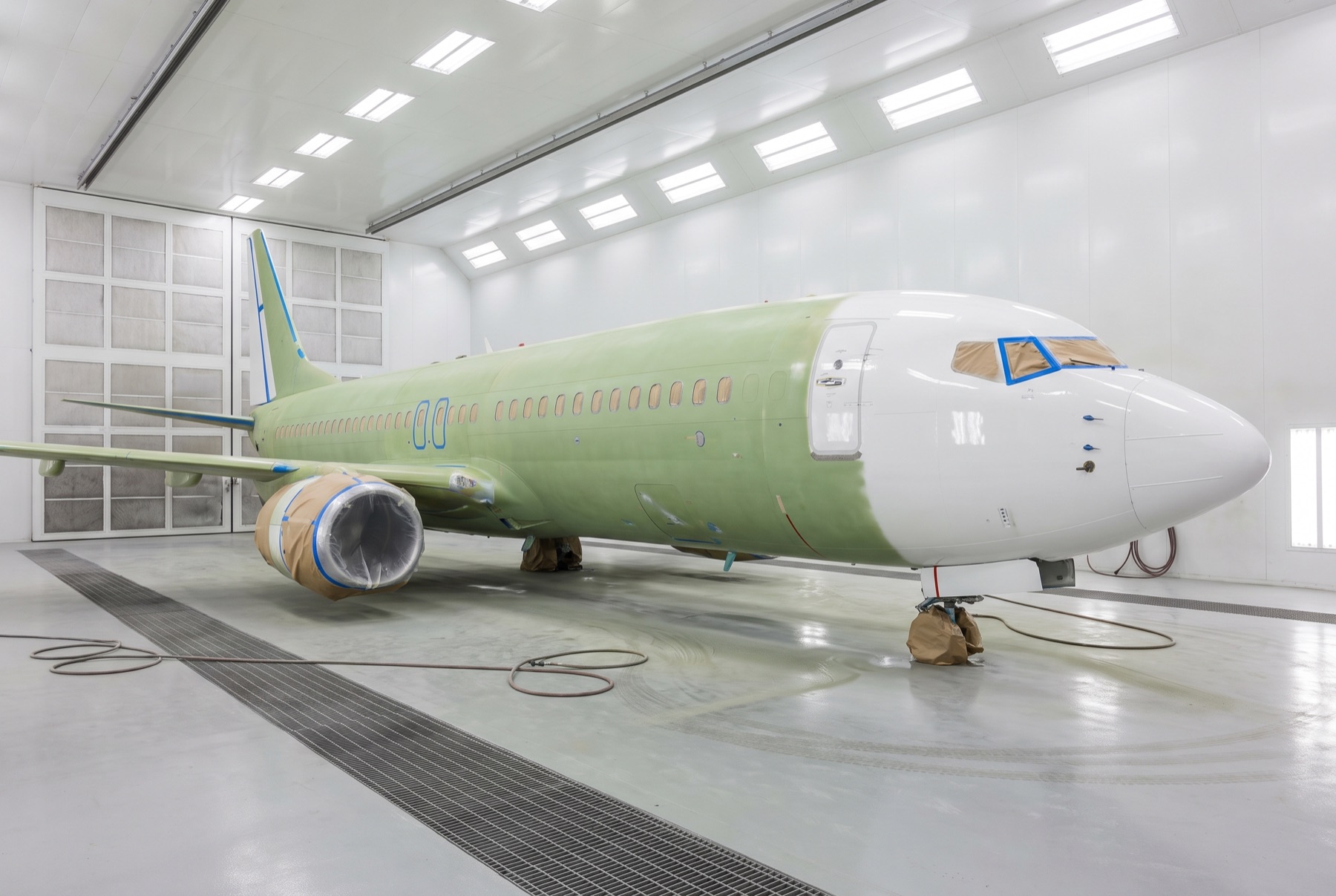
- An aircraft painting hangar is classified around the aircraft itself: Division 1 within 10 ft of its surfaces, Division 2 out to 30 ft.
- Blast booths and wash bays are different problems — dust and water rather than vapor — and a Class I approval does not automatically cover them.
- The approval label on the lift has to match the class, division, group and temperature code on your area classification drawing. Nothing else counts.
What is a paint booth man lift?
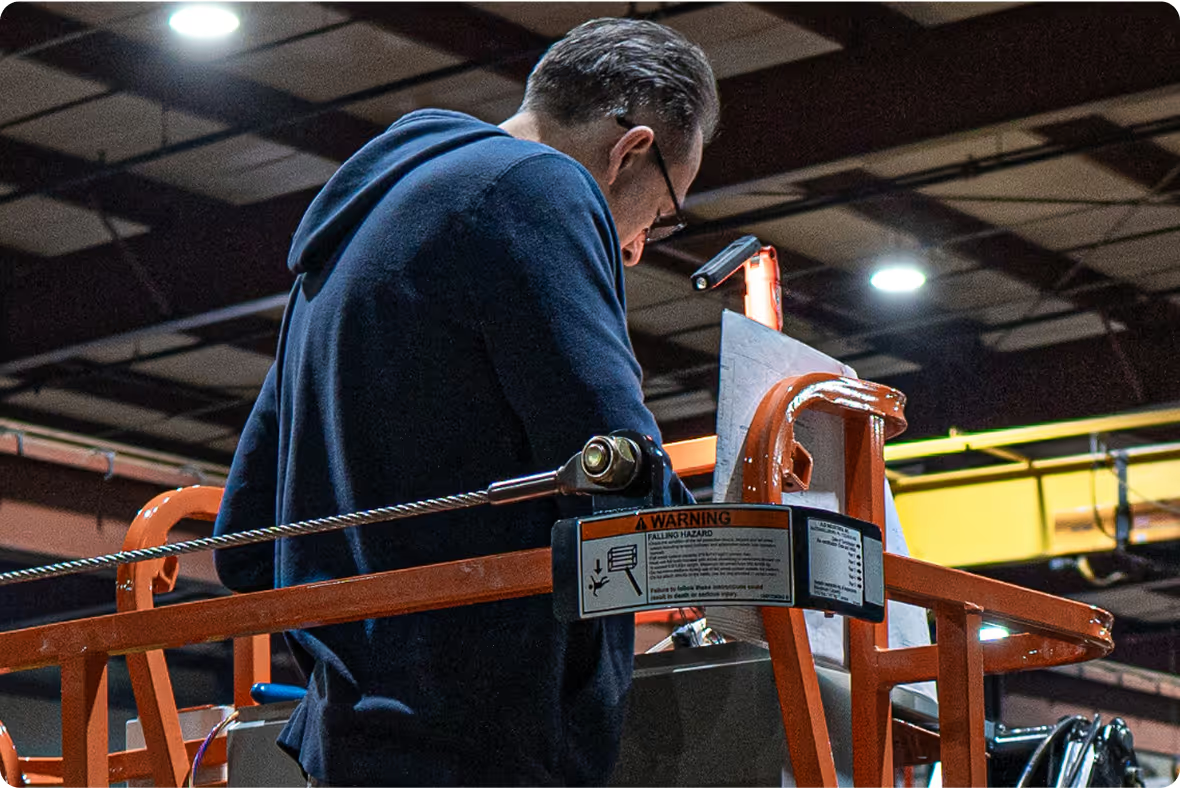
A paint booth man lift is a personnel lift built to raise painters, blasters or inspectors inside a spray-finishing space without bringing an ignition source in with them. There are two families: fixed pneumatic lifts that are built into the booth and run on compressed air, and mobile explosion-proof lifts — scissor or boom lifts certified for the booth's hazardous-location classification.
You will see the same machine called a man lift, manlift, personnel lift, aerial work platform or MEWP. The names are interchangeable; the certification is not. What separates a paint booth lift from the scissor lift in your warehouse is not its shape but the approval label on its chassis.
The category exists because the things that get painted have outgrown ladders and rolling stands. Aircraft, rail cars, transit buses, wind blades, heavy equipment and large weldments all need a painter held at the right height and the right standoff for hours at a time — inside a room full of solvent vapor.
Can you use a regular scissor lift in a paint booth?
No. The inside of a spray booth is a Class I, Division 1 hazardous location, and OSHA's spray-finishing rule bars spark-producing equipment from any spraying area and from within 20 feet of one unless a partition separates them. A standard lift's contactors, motors, switches and battery connections are all ignition sources.
The rule is 29 CFR 1910.107(c): no open flame or spark-producing equipment in a spraying area, and electrical equipment in that area has to be approved for the Class I location. A rental-fleet scissor lift fails that test several ways at once:
- Contactors and relays arc every time they switch.
- Brushed motors spark continuously in normal operation.
- Switches, connectors and joysticks are unsealed.
- Motor and controller surfaces can run hotter than the ignition temperature of the vapor around them.
- Tires and moving parts build up and discharge static.
Our explosion-proof man lift buyer's guide covers how each of those is engineered out of an EX machine.
The mistake we see most often is treating the hazard as something that switches off with the spray gun. The classification describes the space, not the moment. Solvent is still flashing off the part, residue is on the floor and the filters, and somebody is cleaning a gun. Unless your facility has a documented procedure for declassifying the booth that your authority having jurisdiction (AHJ) has accepted, the rule applies whether or not anyone is spraying.
How paint booths and paint hangars are classified
Inside a spray booth or spray room is Class I, Division 1. The space within 3 feet of any booth opening is Class I, Division 2. In an aircraft painting hangar the classification follows the aircraft: Division 1 within 10 feet of its surfaces, Division 2 from 10 to 30 feet. A lift has to be approved for the most demanding area it will enter.
| Where the lift will be | Typical classification | Source |
|---|---|---|
| Inside an enclosed spray booth or spray room | Class I, Division 1 | NFPA 33; NEC Article 516 |
| Within 3 ft of any opening in a spray booth | Class I, Division 2 | NFPA 33; NEC Article 516 |
| Around open-floor (unenclosed) spraying | Class I, Division 2 for 20 ft horizontally and 10 ft vertically beyond the spray area | NFPA 33; NEC Article 516 |
| Aircraft painting hangar — within 10 ft of aircraft surfaces, floor to 10 ft above the aircraft | Class I, Division 1 | NEC 513.3(C)(2) |
| Aircraft painting hangar — 10 to 30 ft from aircraft surfaces, floor to 30 ft above the aircraft | Class I, Division 2 | NEC 513.3(C)(2) |
| Any spraying area, and within 20 ft of it with no partition between | No spark-producing equipment; Division 2 equipment inside the 20 ft | OSHA 29 CFR 1910.107(c) |
| Powder coating booth | Class II (combustible dust) | NFPA 33; NEC Article 516 |
Distances are from current editions of the NEC (NFPA 70) and NFPA 33. Earlier editions used 5 ft and 10 ft boundaries at open-face booths, so check the edition your jurisdiction has adopted. Your facility's area classification drawing and your AHJ always govern.
Two things in that table surprise people.
First, in a paint hangar the Division 1 zone is drawn around the aircraft, not the building. A lift working a fuselage crown, a vertical stabilizer or the top of a wing is inside the 10-foot envelope by definition. There is no position from which you can paint an aircraft and stay out of Division 1, which is why aerospace paint hangars specify Class I, Division 1 lifts as a matter of course.
Second, the classification does not stop at the booth door. A lift that parks, stages or charges just outside an opening can be standing in a Division 2 area.
Class and division are only half the label. The group identifies the vapor — the most common paint solvents, including toluene, xylene, MEK and acetone, are Group D — and the temperature code caps how hot any surface on the machine may get. Both come off your safety data sheets and your classification drawing, and both have to match the lift. Facilities classified under the Zone system will see Class I, Zone 1 and Zone 2 in place of Division 1 and Division 2.
Fixed pneumatic booth lifts vs. mobile explosion-proof lifts
Fixed pneumatic lifts are built into the booth and run on shop air, so they suit dedicated booths that paint similar parts every day. Mobile explosion-proof lifts are self-propelled scissor or boom lifts certified for the classified area, so they suit aircraft, oversized or one-off workpieces, and facilities with more than one bay.
| Fixed pneumatic booth lift | Mobile explosion-proof lift | |
|---|---|---|
| Power | Compressed air | Battery-electric, with an explosion-proof electrical system |
| Installation | Mounted to the booth wall, a rail or a floor track; part of the booth build | Drives in; no changes to the booth |
| Coverage | The wall or rail it rides on — typically up and down, in and out, and along the booth | Anywhere the floor goes: around, under and over the workpiece |
| Moves between bays | No | Yes |
| Best for | Dedicated booths; repetitive part shapes; truck, rail and equipment finishing lines | Aircraft paint hangars; changing airframes; large or irregular parts; multi-bay facilities; booths with no lift structure |
| Main limitation | Fixed working envelope; the booth has to be designed and piped for it | Needs a rated floor path, and a place to charge outside the classified area |
| What to verify | That the lift, including any controls, sensors and static bonding, is documented for the booth's classification | The approval label: class, division, group and temperature code, for the complete machine |
Neither is the better lift. A truck-body line that paints the same envelope forty times a week is well served by lifts that ride the booth walls. A hangar that paints a regional jet this month and a widebody the next is not — the workpiece changes shape, and the lift has to go where the airframe is.
One caution on pneumatics: air-powered does not automatically mean approved. Taking the electric motor out removes the biggest ignition source, but static, friction heat, and any solenoid, sensor or light on the lift still have to suit the classification. Ask for the same documentation you would for an electric machine.
Plenty of facilities run both: fixed lifts in the production booths, and a mobile explosion-proof lift for touch-up, oversize work and the jobs the fixed envelope cannot reach. Bailey builds the mobile kind, along with custom and pedestal-mounted lifts where a standard chassis will not do.
Aerospace paint hangars: what the lift has to do
An aerospace paint booth man lift has to do three things at once: carry a Class I, Division 1 approval, reach every surface of an airframe that changes from one tail number to the next, and never touch the aircraft. The third requirement is the one generic lifts are not built for.
Reach the whole airframe
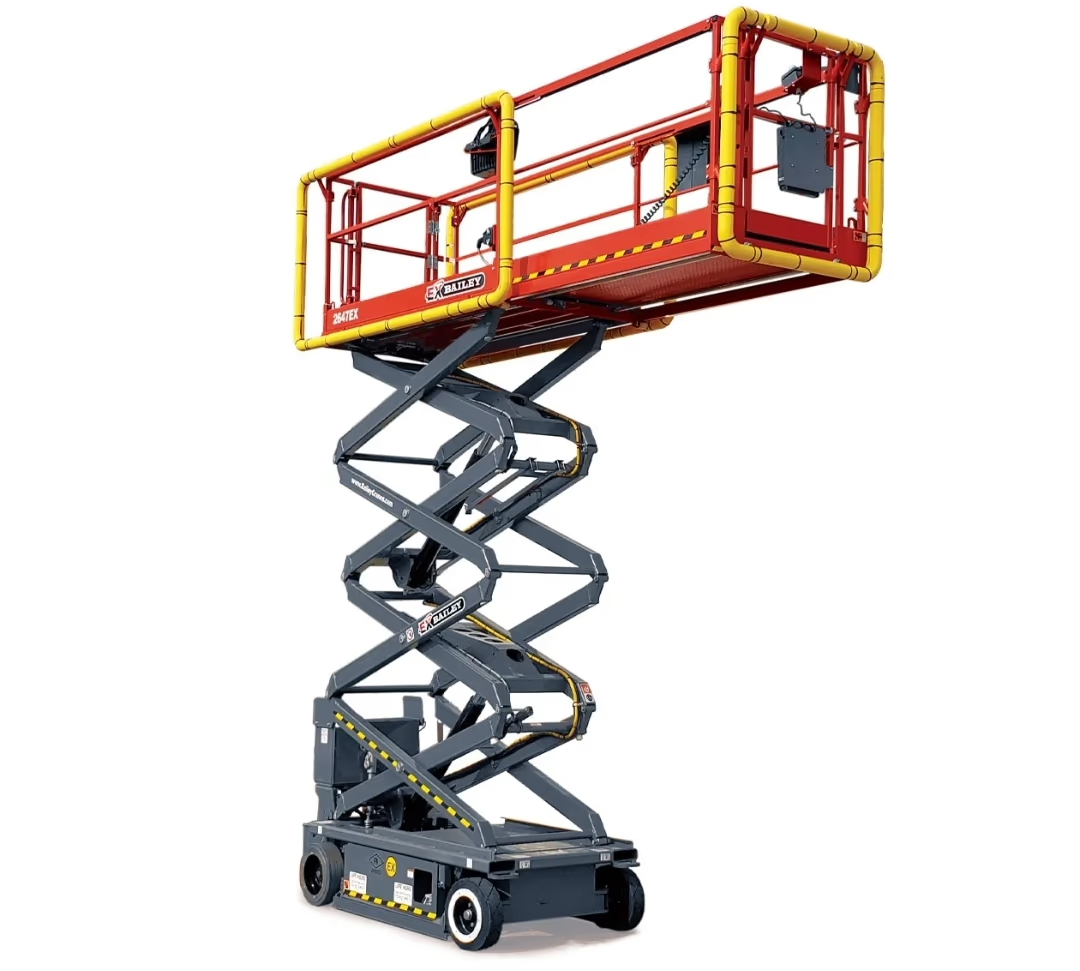
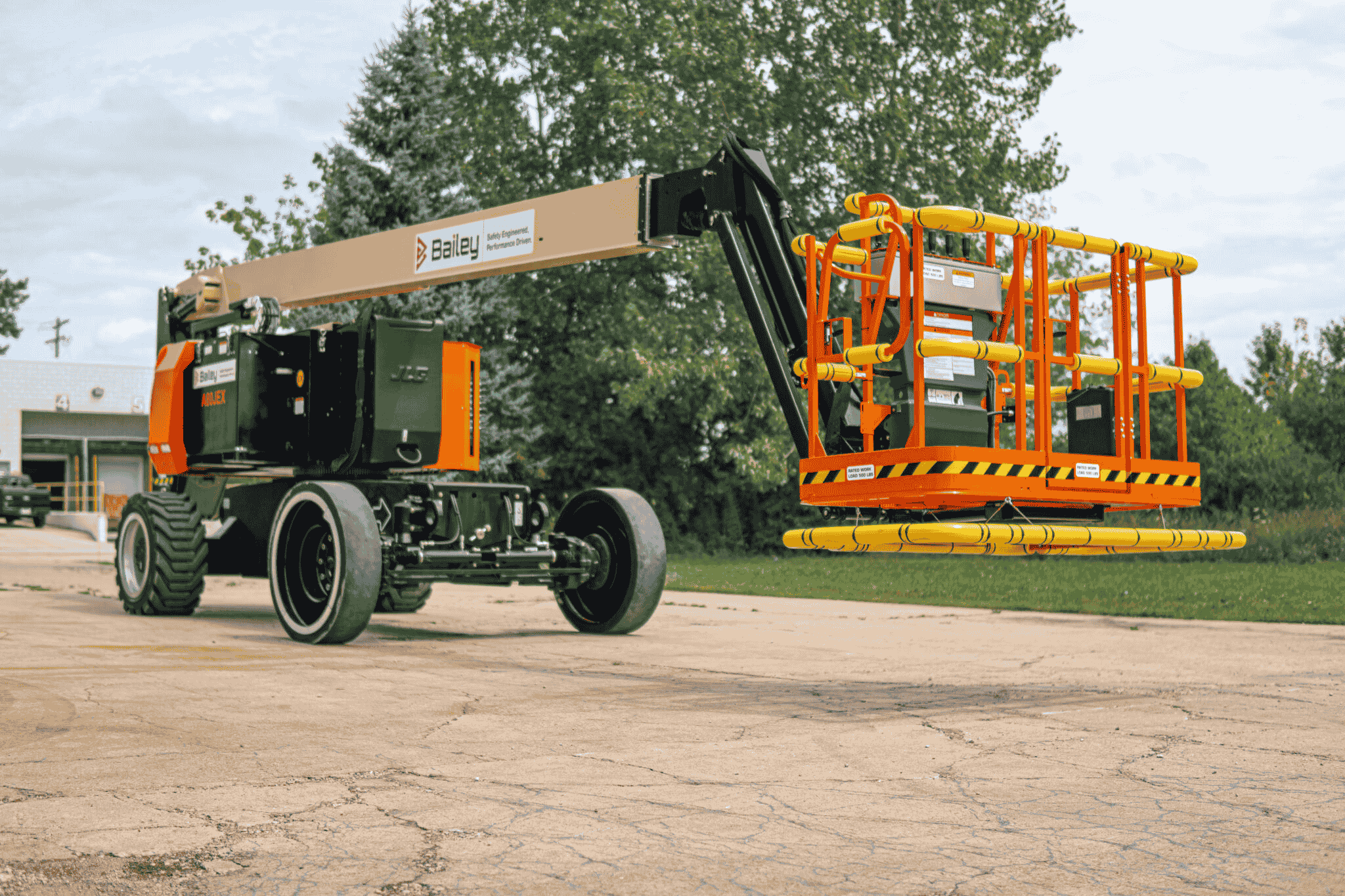
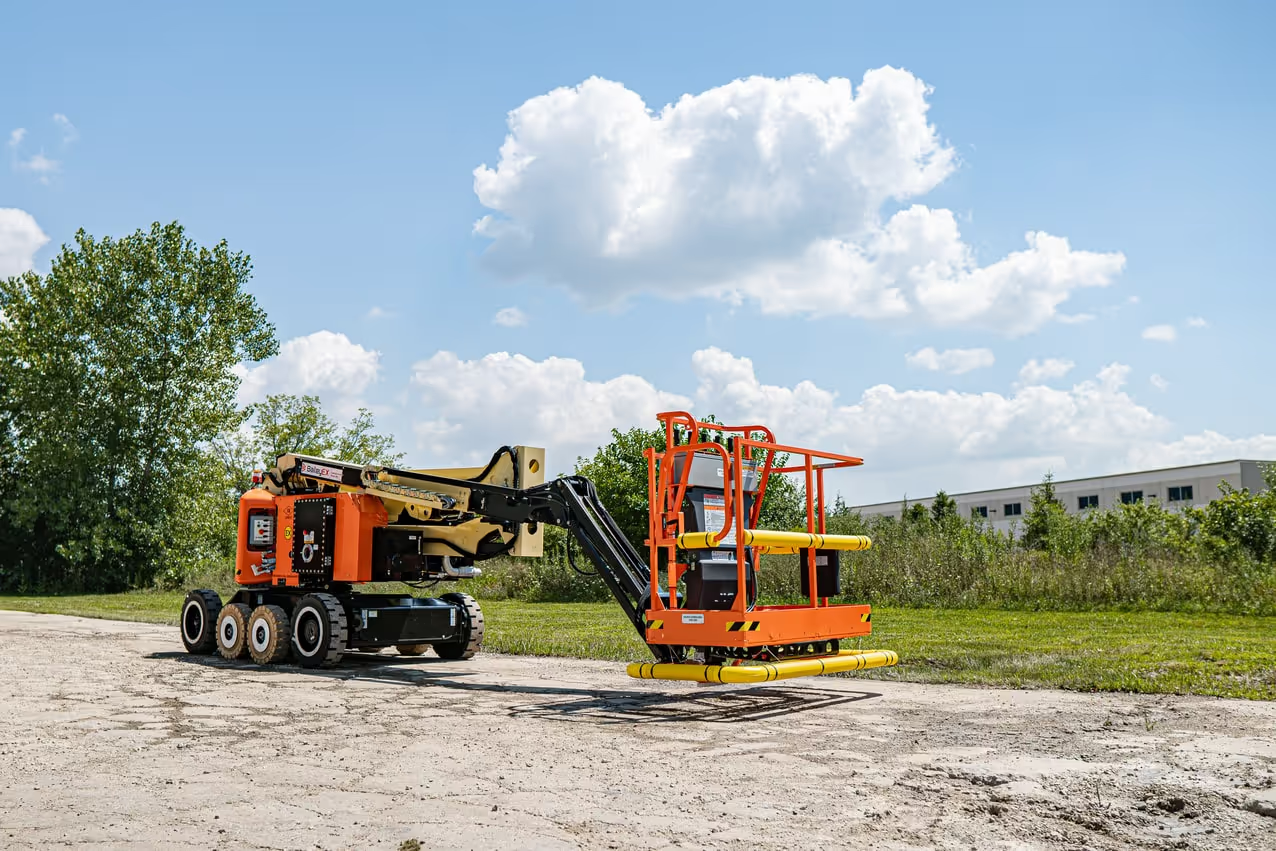
Scissor lifts cover fuselage sides, the belly, nacelles and under-wing work. Articulating booms go up and over a wing to the crown and the tail. Telescopic booms give long, straight reach. Bailey's EX range runs from 25 to 59 ft of working height on scissor lifts and from 36 to 86 ft on articulating and telescopic booms.
Position without repositioning
The Omni-Drive upgrade gives a scissor lift 360-degree maneuverability, so the operator can work along a fuselage instead of backing out and re-approaching for every panel.
Protect the aircraft
Padded Aircraft Rails wrap the platform in replaceable, Skydrol-resistant urethane foam bumpers. The Soft Touch System adds a guard at the base of the platform that halts machine motion the moment it makes contact.
Protect the painter
A 270-degree fall arrest system uses a sliding anchor point that travels with the operator, so both hands stay on the gun and the hose.
Light the work
Task lighting inside a classified area has to carry its own approval. Bailey's portable EX light is an explosion-proof, rechargeable LED unit certified by Intertek.
The lift is in the hangar for more than color. Masking, sanding, depaint, sealing, inspection and decal work all happen from the same platform, which is why duty cycle and platform capacity matter as much as height.
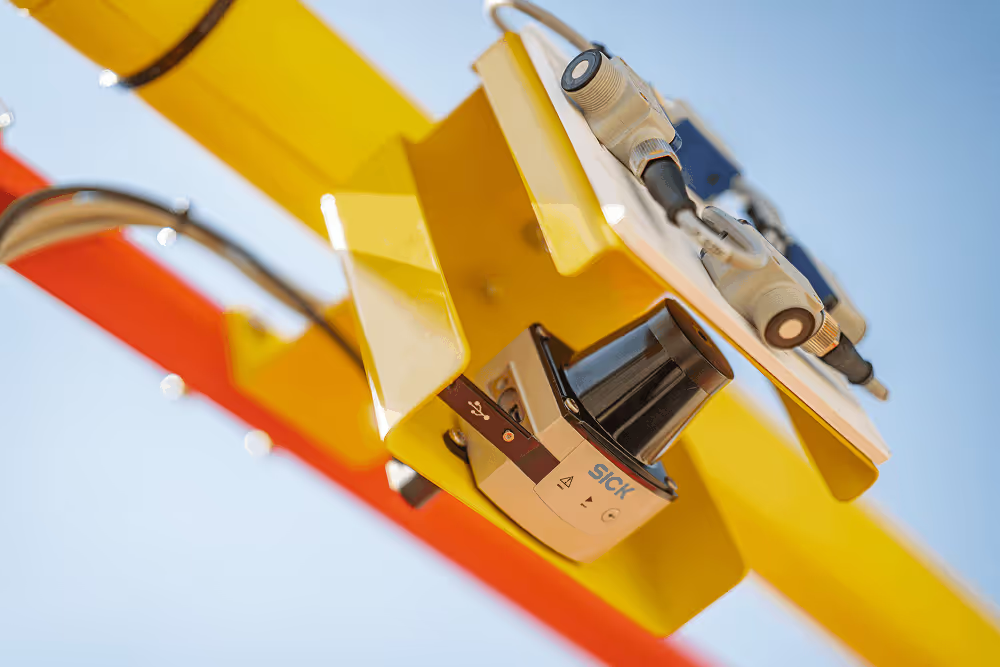
Where the classification allows it, sensor-based collision avoidance adds another layer of protection for the airframe. Raise it at the specification stage, because the sensors have to suit the area too.
Bailey's EX lifts work in aircraft painting operations at Boeing, Lockheed Martin, Gulfstream and Bombardier. For the wider hangar picture, see our guides to explosion-proof equipment in aircraft MRO facilities and OSHA, NFPA and UL compliance in aircraft maintenance.
Blast booths: dust changes the question
A blast booth is not automatically a hazardous location. It becomes one when the dust is combustible — which depends on the blast media, the coating being removed and the metal underneath. Combustible dust is a Class II hazard, and a lift approved only for Class I is not approved for it.
OSHA's abrasive blasting rule, 29 CFR 1910.94(a), says that where flammable or explosive dust mixtures may be present, the equipment and all electric wiring have to meet the hazardous-location requirements. Whether that applies to your booth is a question about your dust:
- The media. Organic and plastic media can be combustible in their own right. Mineral abrasives such as garnet and aluminum oxide are not.
- The coating. Old paint, primer and sealant come off as fine organic dust.
- The substrate. Aluminum, magnesium and titanium dust can be combustible.
The way to settle it is a dust hazard analysis, not a guess. If the answer is Class II, the lift's label has to say Class II and name the dust group. We covered why that distinction matters in When Dust Becomes Fuel.
Even an unclassified blast room is hard on a lift. Abrasive gets into scissor pins, cylinder rods, wheel bearings and every enclosure that is not sealed against it, and a standard machine wears out fast. For blast work, specify the protection as carefully as the reach: boots on cylinder rods, sealed enclosures, shielded pivots, and a maintenance schedule built around abrasive. Combination blast-and-paint rooms have to satisfy both sets of requirements.
Wash booths and wash bays: water, chemistry and footing
A wash booth is classified by what is being sprayed and what is being washed off, not by the water. Detergent-and-water washing of clean parts is usually unclassified. Solvent-based cleaners, or parts still wet with fuel or solvent, can make the bay a Class I location. Either way, the lift has to survive water, chemicals and a wet floor.
Three checks cover most wash-bay specifications:
- Classification. Ask your EHS team what is used in the bay and where the bay sits. A wash bay that shares air with a paint booth, or falls inside its Division 2 boundary, takes on that classification.
- Ingress and corrosion. An explosion-proof enclosure is not automatically a washdown enclosure; the two are specified separately. If the lift will be sprayed directly, say so — and say what with. Alkaline cleaners and acid brighteners are hard on fasteners, seals and coatings.
- The floor. Wash bays slope to drains and are often floored with trench grating. Check the grating's rated load against the lift's wheel loads, check the slope against the lift's rated operating slope, and specify slip-resistant decking on the platform.
High-solids, waterborne and powder coatings: does the coating change the lift?
Rarely. High-solids coatings carry less solvent, but what is left is still typically flammable, and a booth is classified for the most hazardous material used in it — including gun-cleaning and wipe-down solvents. Powder coating swaps vapor for combustible dust, which calls for a Class II approval instead.
- High-solids. Same classification, more weight. High-solids systems often mean heavier hose bundles and more gear on the platform, so check platform capacity against the real load, not just the painter.
- Waterborne. Many waterborne coatings still contain flammable co-solvents, and the booth almost always sees solvent at cleanup. A booth that never sees a flammable liquid may be classified differently, but that is the AHJ's decision on the evidence of your safety data sheets, and few production booths qualify.
- Powder. The hazard is combustible dust, so the classification is Class II. A lift approved only for Class I is the wrong machine.
If the booth's coatings are changing — and under tightening VOC rules they usually are — buy for the most demanding material you expect to run, not the one in the pot today.
EE vs. EX: which rating does a paint booth need?
EX. The type designations come from the industrial-truck standards, UL 583 and NFPA 505. E and ES are for ordinary locations, EE adds fully enclosed electrical equipment, and EX is the only type built for atmospheres that contain flammable vapors. A Division 1 spray area needs EX. EE may be acceptable in some Division 2 areas if your AHJ agrees.
| Type | What it means | Where it belongs |
|---|---|---|
| E | Minimum acceptable safeguards against fire and electric shock | Ordinary, unclassified locations |
| ES | E, plus added safeguards to prevent hazardous sparks and limit surface temperatures | Ordinary locations |
| EE | ES, plus motors and all other electrical equipment completely enclosed | Some Division 2 areas, subject to the AHJ |
| EX | Electrical fittings and equipment designed, constructed and assembled for use in atmospheres containing flammable vapors or dusts | Class I, Division 1 and Division 2, for the group marked on the label |
The designations were written for industrial trucks, and the hazardous-location lift market uses the same language. Definitions follow 29 CFR 1910.178(b).
The practical trap is the lift that will "only" work near the booth. If its travel path, parking spot or working position crosses into Division 1 even occasionally, it needs to be EX.
How to verify a lift before it goes in the booth
Read the approval label on the machine. It should name the testing laboratory — FM Approvals, UL or another nationally recognized testing laboratory — and the class, division, group and temperature code the complete machine is approved for. Then match all four against your area classification drawing.
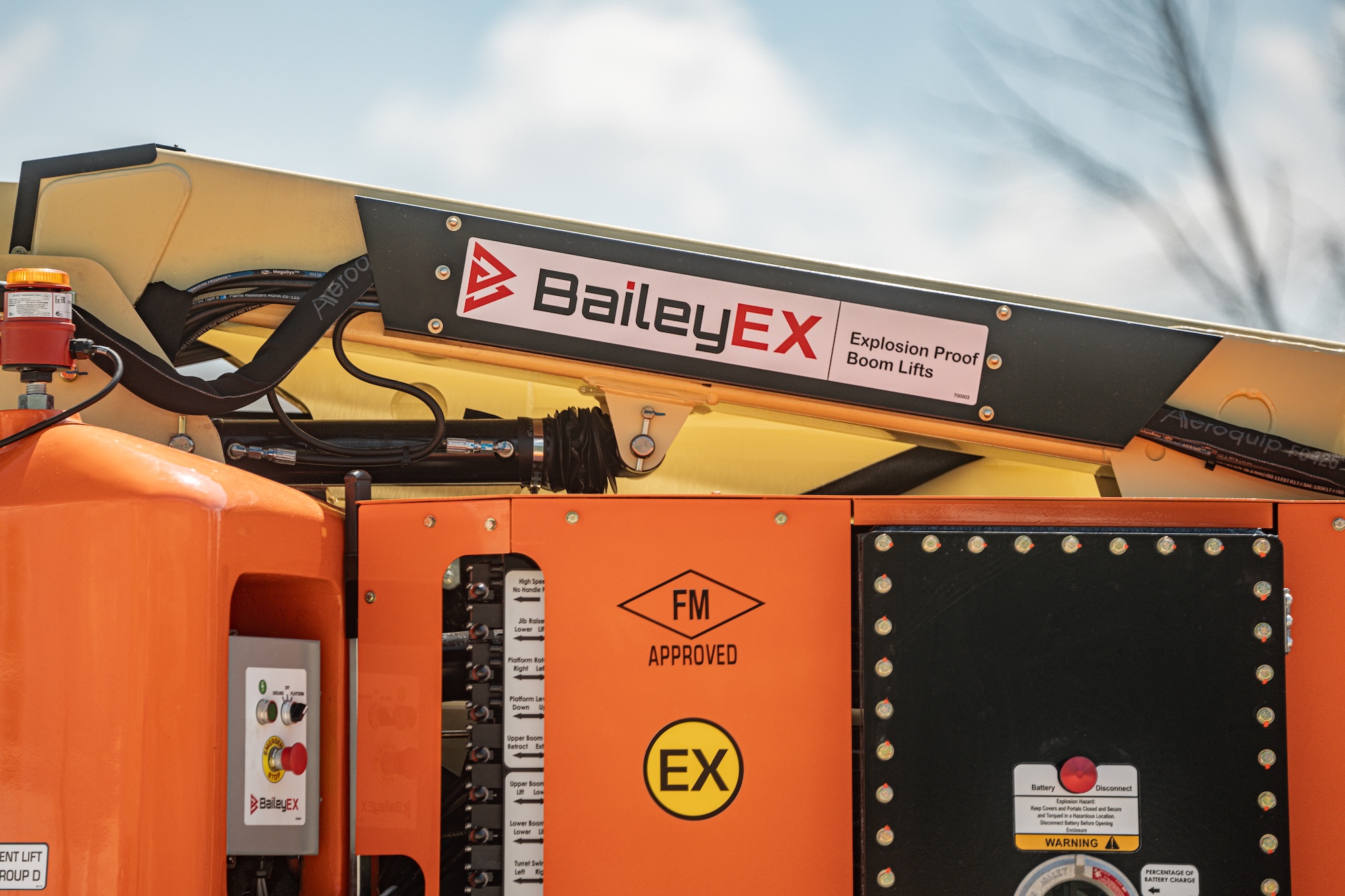
- Start with the drawing. Your area classification drawing gives the class, division, group and temperature code for every area the lift will enter, including where it parks.
- Read the nameplate. Look for the laboratory's mark and all four values. A label that says only "explosion-proof" tells you nothing.
- Look it up. Approvals are listed in the certifier's public directory. A real one can be found there.
- Confirm it covers the whole machine. A lift assembled from individually rated parts is not an approved lift.
- Ask what happens when it is modified. Attachments, repairs and field changes to an approved machine have to go through the manufacturer, or the approval no longer describes what is in your booth.
- Keep the paperwork with the machine. Your insurer and your AHJ will both ask for it.
Bailey's EX lifts are FM Approved for Class I, Division 1 as complete machines, and we engineer each one to the class and division on the customer's drawing.
The spec sheet to send your supplier
Send these and you will get a specific machine recommendation instead of a brochure. Most of it comes off documents you already have: the classification drawing, the booth drawings and the safety data sheets.
- Area classification — class, division, group and temperature code, and the drawing if you can share it
- What is sprayed, blasted or washed — coating types, cleanup solvents, blast media, wash chemistry
- The workpiece — aircraft types or part envelope, largest and tallest
- Highest work point — and the horizontal reach needed to get to it, including anything you have to reach over
- Booth or hangar interior — clear height, door opening width and height, and the route in
- Floor — solid slab, grating or trench exhaust; rated load; slope to drains
- Platform load — number of people, plus guns, hoses, breathing-air lines and tools
- Surface protection — how close the platform works to finished surfaces, and whether padded rails or contact sensing are required
- Fall protection — anchorage requirements and how far the operator moves along the platform
- Lighting and air — any need for approved task lighting, breathing air or process air at the platform
- Charging and storage — where the lift will charge and park, normally outside the classified area
- Duty — shifts per day, and how many bays one lift has to serve
- Site rules — customer, insurer or AHJ requirements beyond code
Bailey's explosion-proof lifts for finishing work
Bailey Cranes developed its EX Series explosion-proof lifts in 2002 and builds them in Muskego, Wisconsin. The line is FM Approved for Class I, Division 1 and covers 21 scissor and boom models. These are the ones most often matched to paint, blast and wash work:
| Model | Type | Working height | Platform capacity | Overall width |
|---|---|---|---|---|
| 1932EX | Scissor | 25 ft | 550 lb | 32 in |
| 2647EX | Scissor | 32 ft | 1,000 lb | 47 in |
| 3247EX | Scissor | 38 ft | 700 lb | 47 in |
| 4392EX | Scissor | 49 ft | 2,000 lb | 90.6 in |
| 5392EX | Scissor | 59 ft | 1,500 lb | 90.6 in |
| A45JEX | Articulating boom | 51 ft | 500 lb | 6 ft 6 in |
| A60JEX | Articulating boom | 66 ft | 500 lb | 8 ft |
| A80JEX | Articulating boom | 86 ft | 500 lb | 8 ft |
| T40EX | Telescopic boom | 45 ft | 1,000 lb | 7 ft 7 in |
| T80EX | Telescopic boom | 85 ft | 1,000 lb | 8 ft 2 in |
Specifications as published on the product pages. Browse the full explosion-proof line.
Standard EX scissor and boom models typically ship in 12 to 20 weeks. Fully custom configurations run 24 to 40 weeks because of certification testing and validation, so the classification conversation is worth having early in a booth or hangar project rather than at commissioning.
Send us your classification and your reach
Give us the class, division and group, the highest point you need to reach, and what you are painting, blasting or washing. We'll tell you which EX lift fits — or engineer one that does.
Paint booth man lift FAQ
What is a paint booth man lift?
A paint booth man lift is a personnel lift built to raise painters, blasters or inspectors inside a spray-finishing space without introducing an ignition source. There are two families: fixed pneumatic lifts built into the booth and powered by compressed air, and mobile explosion-proof scissor or boom lifts certified for the booth's hazardous-location classification.
Can you use a regular scissor lift in a paint booth?
No. The inside of a spray booth is a Class I, Division 1 hazardous location, and OSHA 29 CFR 1910.107(c) bars spark-producing equipment from any spraying area and from within 20 feet of one unless a partition separates them. A standard scissor lift's contactors, motors, switches and battery connections are all ignition sources.
What class and division is a paint booth?
Under NFPA 33 and NEC Article 516, the interior of a spray booth or spray room is Class I, Division 1, and the space within 3 feet of any booth opening is Class I, Division 2. Around unenclosed spraying, Division 2 extends 20 feet horizontally and 10 feet vertically beyond the spray area. Powder coating booths are Class II. Always confirm against your facility's area classification drawing.
What is the hazardous classification of an aircraft paint hangar?
Under NEC 513.3(C)(2), the area within 10 feet horizontally of the aircraft's surfaces, from the floor to 10 feet above the aircraft, is Class I, Division 1. The area from 10 to 30 feet out, from the floor to 30 feet above the aircraft, is Class I, Division 2. A lift working on the airframe is therefore inside Division 1.
Are pneumatic man lifts explosion-proof?
Not automatically. A pneumatic lift removes the electric motor, which is the largest ignition source, but static discharge, friction heat and any solenoid, sensor or light on the lift still have to suit the classification. Ask for the lift's hazardous-location documentation the same way you would for an electric machine.
Do blast booths require explosion-proof lifts?
Only when the dust is combustible. That depends on the blast media, the coating being removed and the substrate: organic and plastic media, paint dust, and aluminum, magnesium or titanium dust can all be combustible. Combustible dust is a Class II hazard, so the lift must be approved for Class II, not just Class I. A dust hazard analysis settles the question.
Do wash booths require explosion-proof lifts?
It depends on the chemistry. Washing clean parts with water and detergent is usually unclassified. Solvent-based cleaners, or parts wet with fuel or solvent, can make the bay a Class I location, and a wash bay inside a paint booth's Division 2 boundary takes on that classification. In every case the lift needs washdown-rated enclosures, corrosion resistance and safe footing on a wet, sloped floor.
Do high-solids or waterborne paints still need an explosion-proof lift?
Usually yes. High-solids coatings contain less solvent but are still typically flammable, many waterborne coatings contain flammable co-solvents, and booths are classified for the most hazardous material used in them, including cleanup solvents. Only the authority having jurisdiction can classify a booth differently.
What is the difference between an EE-rated and an EX-rated lift?
EE-rated equipment has its motors and all other electrical equipment completely enclosed, and may be accepted in some Division 2 areas. EX-rated equipment is designed, built and assembled for use in atmospheres containing flammable vapors or dusts, and is the type required for Class I, Division 1 areas such as the inside of a paint booth.
How do I verify that a lift is approved for my paint booth?
Read the approval label on the machine. It should show the testing laboratory, such as FM Approvals or UL, and the class, division, group and temperature code the complete machine is approved for. Match all four to your area classification drawing and confirm the listing in the certifier's public directory.
What size man lift do I need for an aircraft paint hangar?
Work from the aircraft. Scissor lifts handle fuselage sides, belly and under-wing work; booms reach the crown and vertical stabilizer. Bailey EX scissor lifts offer 25 to 59 feet of working height and EX boom lifts 36 to 86 feet. Send the aircraft types, the highest work point and the hangar door size to get a specific recommendation.
Who makes explosion-proof man lifts for paint booths and aircraft paint hangars?
Bailey Cranes designs and builds FM Approved, Class I, Division 1 explosion-proof scissor and boom lifts in Muskego, Wisconsin, and has produced its EX Series since 2002. Bailey is a Service-Disabled Veteran-Owned, ISO 9001:2015 certified manufacturer whose EX lifts are used in aircraft painting operations at Boeing, Lockheed Martin, Gulfstream and Bombardier.