



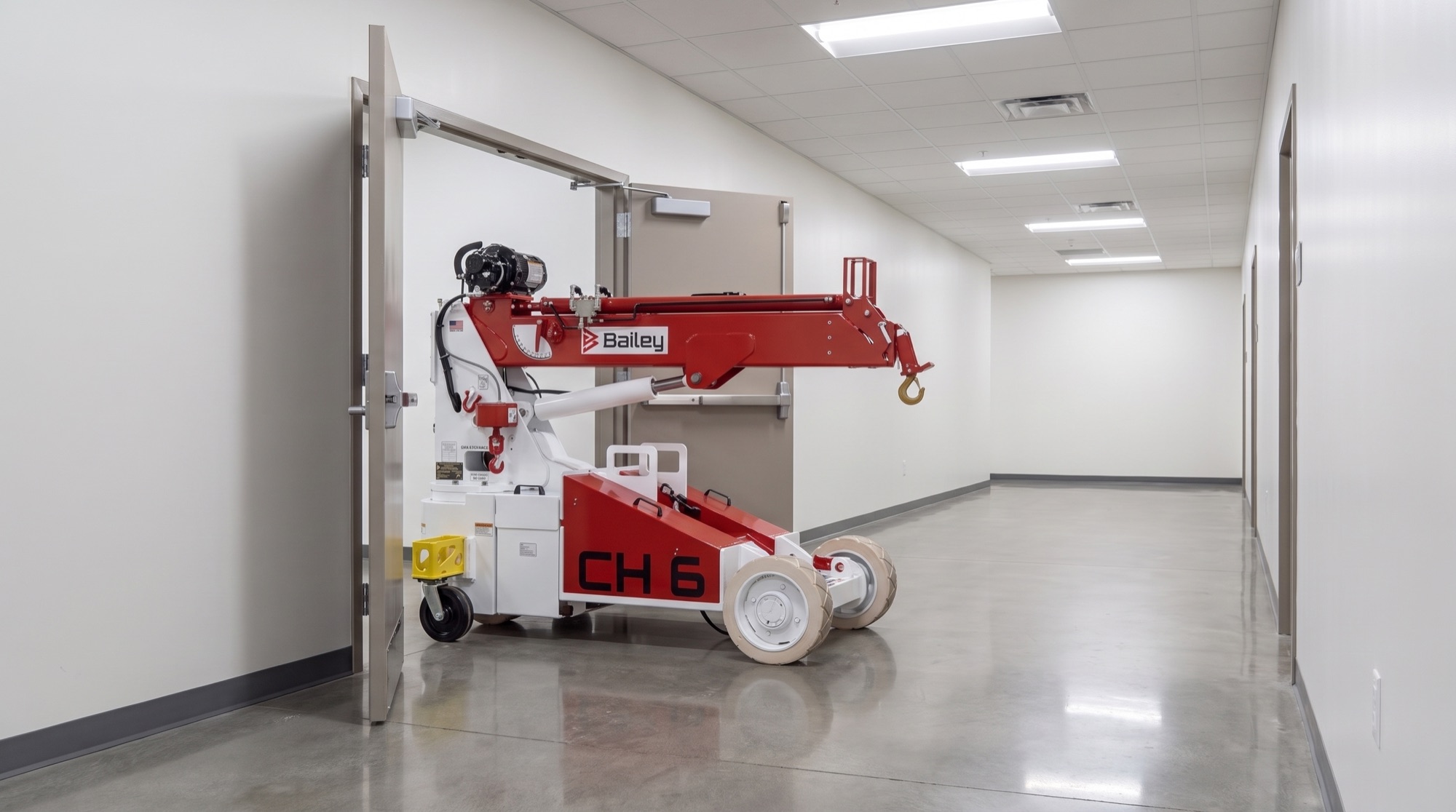
The hard part of an indoor lift is almost never the lift. It's the 36-inch doorway, the slab you're not allowed to crack, the sprinkler main eight feet off the floor, and the fact that nobody will let you run a propane forklift inside a finished building. Pick the machine around those four constraints and the lift takes care of itself.
This guide covers what an indoor crane actually is, the seven types you can realistically put inside a building, and the specific numbers — door widths, floor pressures, stowed heights, power sources — that decide which one fits yours. It ends with a spec sheet you can send to a supplier so you get a straight answer instead of a brochure.
What is an indoor crane?
An indoor crane is any lifting machine designed to operate inside a finished or occupied building — sized to pass through interior openings, light enough for the floor it stands on, and powered so it produces no exhaust in an enclosed space. In practice the term covers two very different families: mobile indoor cranes that drive in through a door and can be moved job to job, and fixed indoor cranes such as overhead bridge and jib cranes that are built into the structure and serve one area permanently.
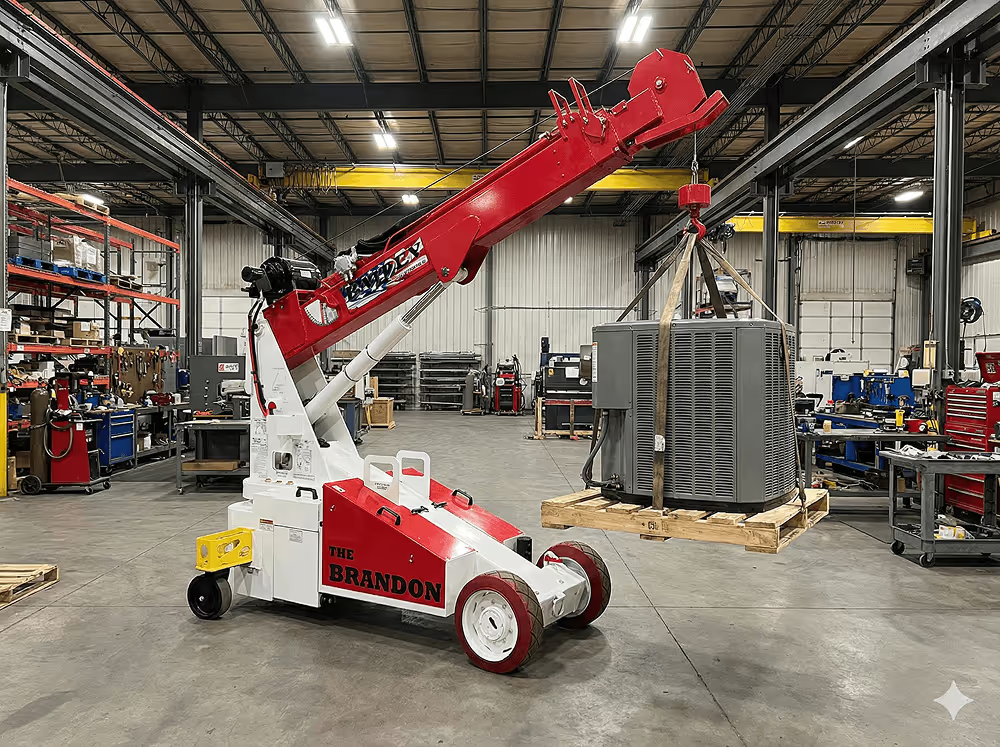
When people search for an "indoor crane," they usually mean the first kind: a compact, self-propelled machine — a pick-and-carry crane or compact handler — that gets a heavy object from the loading dock to its final position inside the building without dismantling a wall.
The distinction matters because it changes the entire buying decision. A bridge crane is a construction project with a structural engineer, a permit, and a six-figure budget, and it only ever serves the bay it was built over. A compact handler is a piece of equipment you buy or rent, drive off a trailer, and use anywhere in the building this week and a different building next month.
It also rules some things out. A truck-mounted crane, a rough-terrain crane, and a standard telehandler are not indoor cranes. They are too tall, too heavy, too wide to turn, and — in most cases — combustion-powered. Trying to force one indoors is how facilities end up with cracked slabs, struck sprinkler heads, and air-quality complaints.
The 7 types of indoor crane, compared
The seven machines that realistically work inside a building are pick-and-carry compact handlers, overhead bridge cranes, jib cranes, portable gantry cranes, spider (crawler) cranes, manual floor cranes, and forklifts fitted with a jib boom. They differ mainly in whether they can move through the building under load, and whether they are fixed to it.
| Type | Fixed or mobile | Typical capacity | Fits a standard doorway? | Best for | Main limitation |
|---|---|---|---|---|---|
| Pick-and-carry compact handler | Mobile, self-propelled | 700 lb – 10,000 lb | Yes — many models fit a double door, some a single | Getting heavy equipment from the dock to its final position anywhere in the building | Needs a continuous floor path with adequate capacity |
| Overhead bridge (EOT) crane | Fixed to the structure | 1 – 100+ tons | N/A — permanently installed | Repetitive, high-volume lifting in one defined bay | Capital install; serves only the area under the runway |
| Jib crane (wall- or floor-mounted) | Fixed | 250 lb – 5 tons | N/A — permanently installed | Workstation and machine-tending lifts | Fixed radius; can't move the load out of its arc |
| Portable gantry crane | Mobile, manually positioned | 1/2 – 5 tons | Usually knocked down and reassembled | Occasional lifts where you can position the frame over the load | Must straddle the load; poor at travelling under load |
| Spider / crawler mini crane | Mobile, tracked | 1,000 lb – 13,000 lb | Some models, retracted | High reach in atriums, glazing and stairwells | Sets up on outriggers; doesn't carry the load around |
| Manual floor crane / engine hoist | Mobile, pushed by hand | 1/2 – 2 tons | Yes | Shop and maintenance work at low height | Very limited reach and height; all-manual |
| Forklift with jib boom attachment | Mobile | Derated from truck capacity | Rarely — turning radius is the problem | Facilities that already own the truck | Load-centre penalty, wide turning circle, exhaust if not electric |
Capacities are typical industry ranges for planning purposes. Always work from the specific machine's load chart, not a category average.
Two of these do something the others cannot: the compact handler and, to a lesser degree, the forklift can pick a load up and carry it somewhere else. Everything else lifts within a fixed footprint. If the problem you are solving is "this 4,000 lb cabinet is on the dock and it needs to be in the room at the far end of the building," that single capability decides the whole exercise.
The four constraints that decide which indoor crane fits
Almost every indoor lifting project that goes wrong went wrong on one of four numbers. Check them in this order — each one eliminates machines, and there is no point sizing capacity until you know what can physically get to the work.
The opening — can it physically get in?
Door and aisle widths, corner geometry, and the machine's stowed height and turning radius. This constraint eliminates more machines than capacity ever does.
The floor — can it take the pressure?
Slab capacity, elevated decks, raised access floors, and the surface pressure under wheels and outriggers. A machine that fits through the door can still be too heavy for where it needs to stand.
The headroom — what's above the load?
Sprinkler mains, ductwork, cable tray, lighting and suspended ceilings. Indoors, stowed height and available lift height under obstructions matter more than maximum reach.
The power — what are you allowed to run inside?
Combustion exhaust, noise, tire marking, and any classification the room carries. In occupied and finished buildings this frequently rules out everything except battery-electric.
Constraint 1 — The opening
Start with a tape measure, not a catalogue. The controlling dimension is the narrowest clear opening anywhere along the path from the dock to the work — and it is often not the door you were worried about. Door stops, panic hardware, frames, and a partly-open leaf all steal clear width from the nominal size.
| Opening | Typical nominal width | Typical clear width | What it means for machine selection |
|---|---|---|---|
| Single personnel door | 36 in (3'-0") | ~32–34 in | Only the smallest compact handlers and floor cranes |
| Double personnel door | 72 in (6'-0") | ~64–68 in | Most compact handlers, with both leaves open |
| Interior corridor | 44–96 in | varies | Watch the 90° turns, not the straight runs |
| Freight elevator | 48–96 in | varies | Check car capacity and floor rating as well as the door |
| Overhead / roll-up door | 8–12 ft | near nominal | Rarely the limiting factor; the interior path usually is |
Widths are typical North American commercial construction. The ADA minimum clear width at a doorway is 32 in, which is why so many interior man-doors land just above it. Always verify on site.
Two dimensions matter as much as width and are routinely forgotten. The first is turning radius: a machine that fits through a door in a straight line may not be able to make the turn on the far side of it. Multi-directional and crab steering exist precisely for this — being able to travel sideways while keeping a long load square to the aisle turns an impossible corner into a routine one. The second is stowed height, which is the number that gets you under the door frame in the first place.
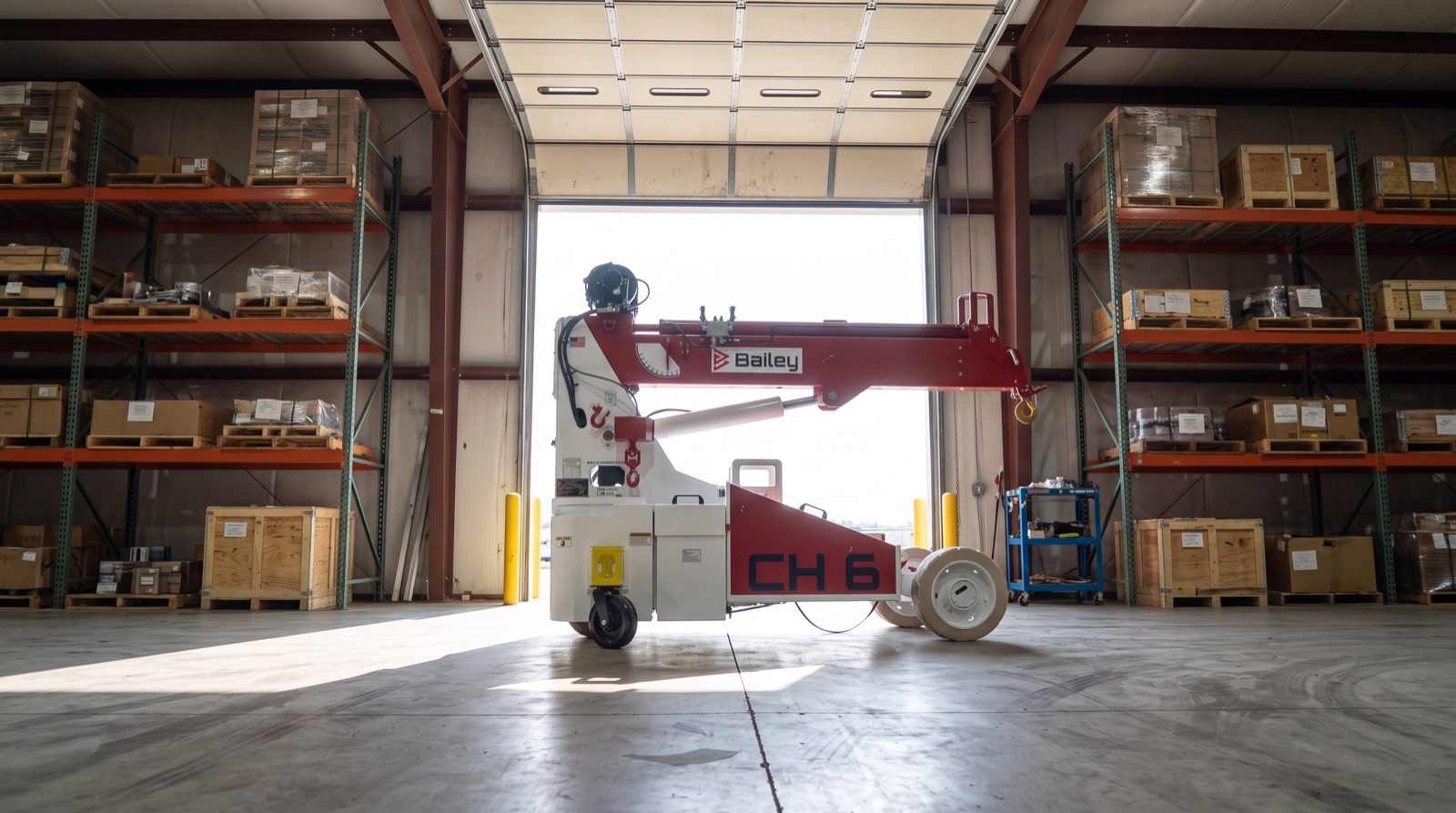
Constraint 2 — The floor
This is the constraint that costs money when it is missed, because the damage shows up after the lift is over. A machine that fits through every door in the building can still be the wrong machine for the floor it has to stand on.
There are three floor situations, and they behave completely differently:
- Slab-on-grade. Ground-level concrete sitting on compacted subgrade. Usually the forgiving case — the risk is not collapse but local damage: punching or spalling under a small, hard contact patch such as a bare steel outrigger foot.
- Elevated or supported slab. Upper floors, mezzanines, and anything spanning a basement, tunnel or utility trench. This is where you need the structural engineer's allowable point load and uniform load in writing before anything rolls onto it — and it is the situation where a lighter machine wins outright.
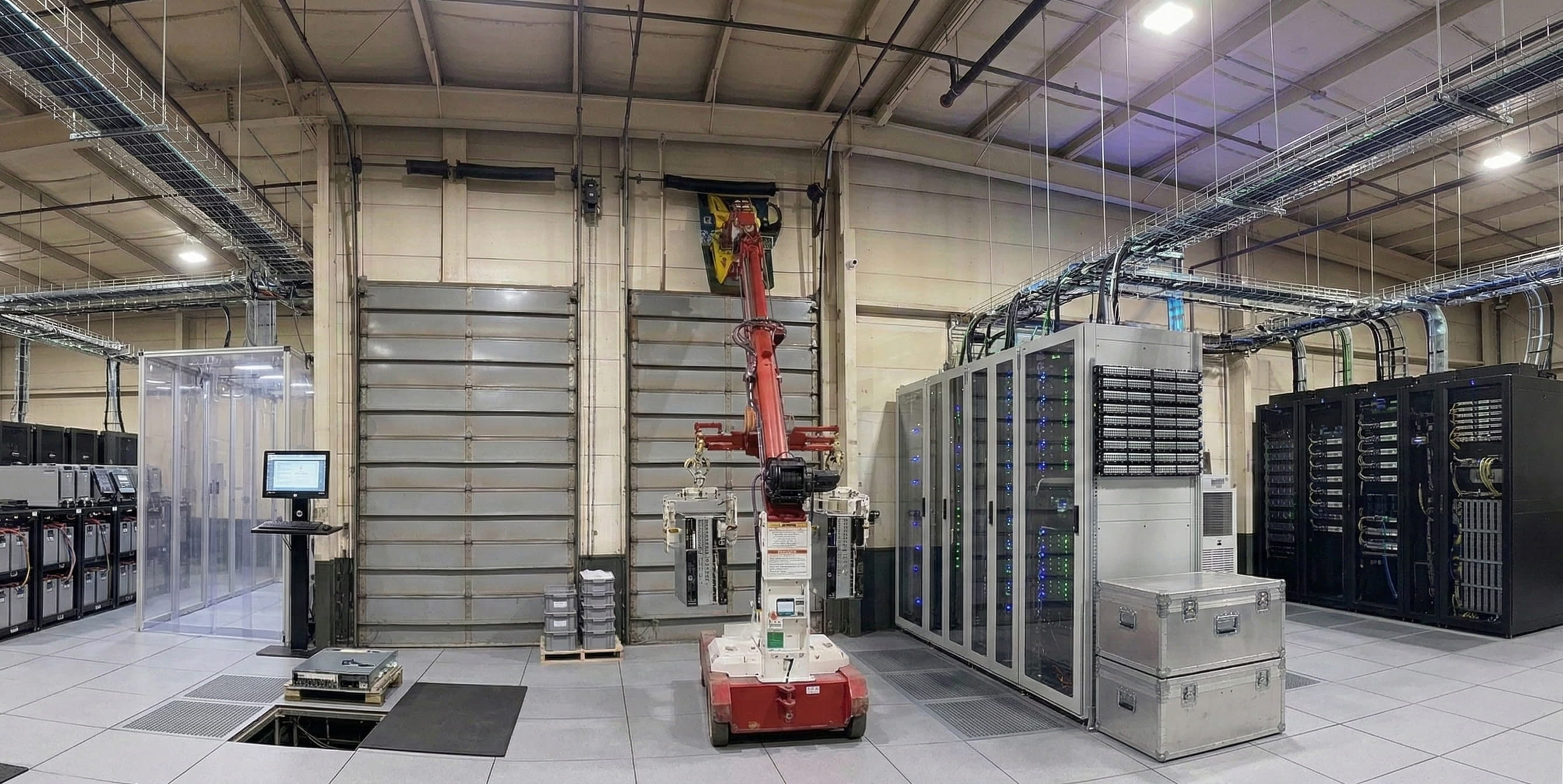
- Raised access floor. Data centres and clean spaces. Individual tiles carry published concentrated and rolling load ratings that a crane will normally exceed, so the machine is almost always supported off the structural slab, or the path is decked to spread the load.
The number that matters is not the machine's weight. It is the pressure that weight produces where it touches the floor — and that depends far more on the contact area you provide than on the machine you chose.
Constraint 3 — The headroom
Outdoors you plan for maximum reach. Indoors you plan for what is in the way. The obstructions that actually govern are sprinkler piping, HVAC ductwork, cable tray and busway, light fixtures, and suspended ceiling grid — and they are rarely at a consistent height across a room.
One code point is worth knowing because it is checkable and non-negotiable: NFPA 13 requires a minimum of 18 in of clearance below sprinkler deflectors for storage. Anything you lift or stack into that zone compromises the sprinkler system's spray pattern, and it is one of the more common findings during an inspection.
So the useful specification indoors is not "how high does it reach" but how much useful lift is available below the lowest obstruction on the path, and whether the boom can be kept stowed low while travelling and only raised at the pick and the set.
Constraint 4 — The power
In an enclosed, occupied or finished building, battery-electric is usually the only practical option. Propane and diesel machines produce carbon monoxide, which accumulates in enclosed spaces — OSHA's permissible exposure limit for CO is 50 ppm as an 8-hour time-weighted average, and running combustion equipment indoors triggers ventilation requirements under the powered industrial truck standard, 29 CFR 1910.178.
Beyond the air itself, three practical points decide it:
- Noise. In an occupied office, hospital, laboratory or live data hall, an engine is disruptive in a way that a battery drive is not — which often decides whether you can work during business hours or have to pay for a night shift.
- Tire marking. Non-marking tires are close to mandatory on finished, coated, or light-coloured floors. Standard black rubber leaves scuffing that is expensive to remove from an epoxy slab.
- Fuel storage and refuelling. Propane cylinder exchange and diesel storage bring their own indoor code requirements. A battery machine sidesteps the entire question.
How to calculate indoor crane floor loading
Add the machine weight, the rated load and the rigging to get gross weight; find the worst-case reaction on a single outrigger or wheel from the manufacturer's chart; then divide that force by the contact area to get pressure. Pressure in psi multiplied by 144 gives psf, which is the unit most structural drawings use.
The step people skip is the second one. Reactions are not distributed evenly. When the boom is extended over one corner, the outrigger on that side can carry a large majority of the gross weight while the opposite corner carries almost nothing. Always use the manufacturer's outrigger reaction data for the actual boom angle and radius — never gross weight divided by four.
Worked example
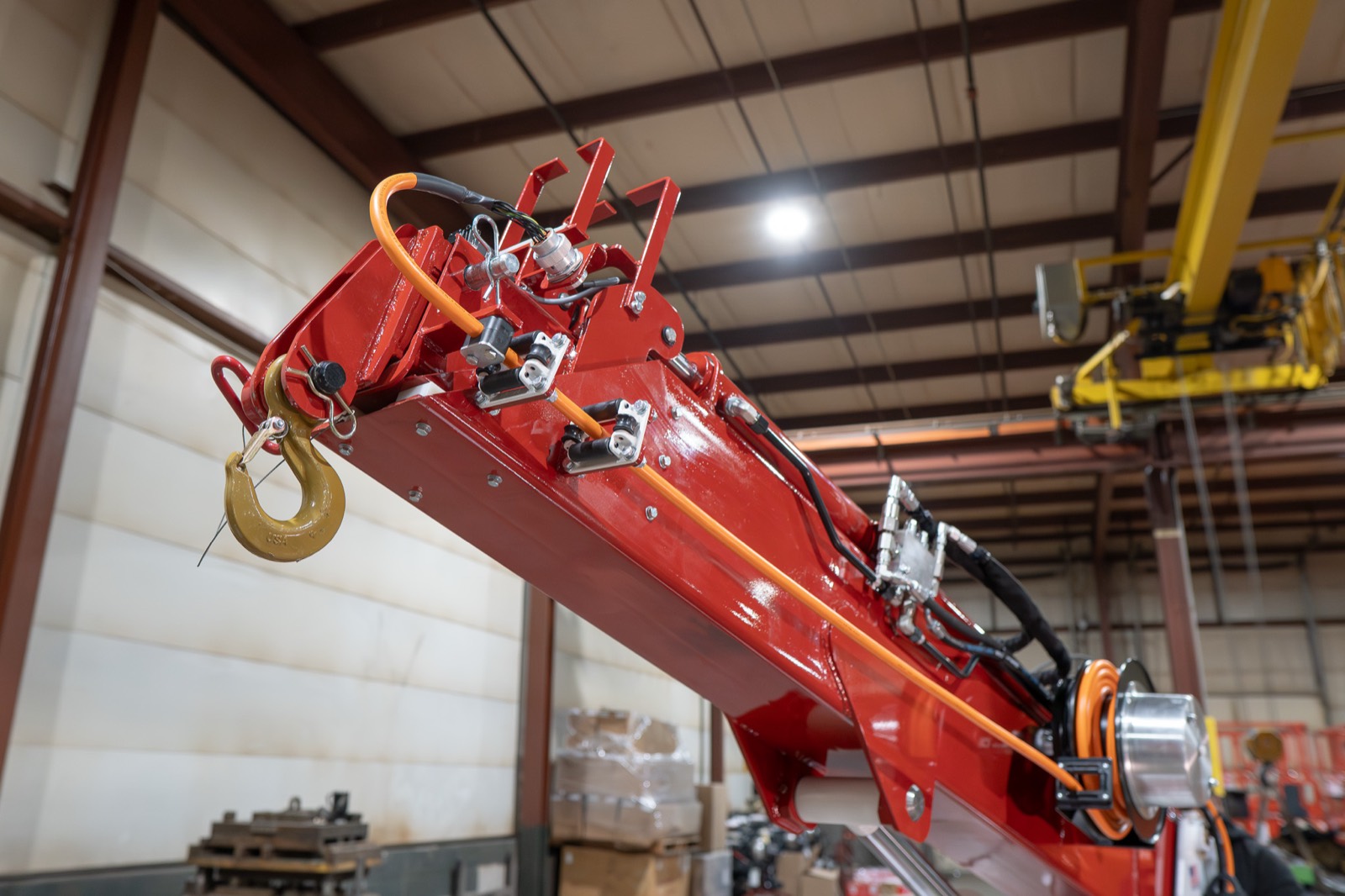
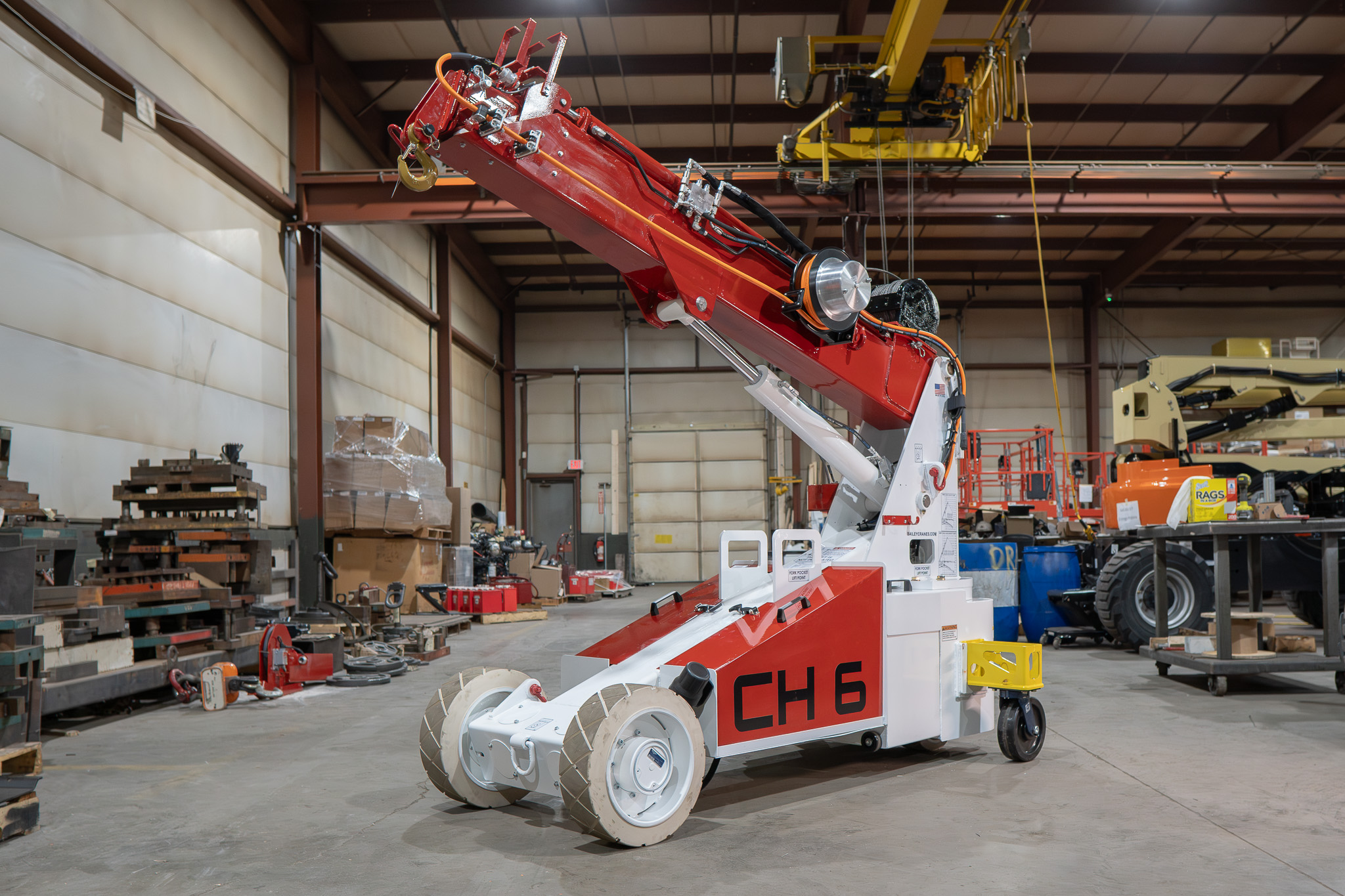
Take a CH 6 Compact Handler: 5,500 lb machine weight, picking its rated 6,000 lb, with roughly 100 lb of rigging.
- Gross weight = 5,500 + 6,000 + 100 = 11,600 lb
- Assume the reaction chart shows a worst-case single-outrigger reaction of 55% of gross at that radius = 6,380 lb on one corner
- Now the contact area does all the work:
| Support under that outrigger | Contact area | Pressure (psi) | Pressure (psf) | Verdict |
|---|---|---|---|---|
| Bare outrigger foot, 8 in × 8 in | 64 in² | 100 psi | ≈ 14,400 psf | Far too concentrated for most finished floors |
| 18 in × 18 in pad | 324 in² | 20 psi | ≈ 2,830 psf | Acceptable on many slabs-on-grade |
| 24 in × 24 in pad | 576 in² | 11 psi | ≈ 1,595 psf | A sensible default for finished interiors |
| 36 in × 36 in pad | 1,296 in² | 4.9 psi | ≈ 710 psf | For elevated decks and rated raised floors |
Illustrative calculation. The 55% reaction figure is an example, not a specification — use the load and reaction charts for your machine, configuration and radius, and have a structural engineer confirm any lift on an elevated slab.
The same machine, the same load, and the same lift can produce 14,400 psf or 710 psf on your floor. The only variable is how much steel or timber you put between the outrigger and the concrete.
This is also the clearest argument for a compact handler over a conventional forklift indoors. A 5,000 lb-capacity counterbalance forklift typically weighs 8,000–11,000 lb before it picks anything up, because it has to counterweight the load — and it puts almost all of that through two small front tire patches while travelling. A compact handler carries less deadweight for the same capacity and, when it sets up, spreads the load across four pads you control the size of.
Outrigger pads are not an accessory. Going from a bare 8-inch foot to a 24-inch pad cuts the pressure on your slab by roughly 90 percent.
Cleanrooms, hazardous locations and other regulated interiors
Some indoor spaces add a fifth constraint that overrides the other four: the room itself is classified, and equipment has to be built for it. A standard machine cannot be made compliant with a wash-down and a sign.
Cleanrooms & semiconductor fabs
Particle-controlled construction, sealed bearings, cleanroom-compatible lubricants and non-shedding finishes — plus non-marking tires that won't contaminate the floor.
Hazardous locations
Paint and blast booths, solvent handling and fuel-cell areas need genuinely explosion-proof equipment, certified as a unit rather than assembled from rated components.
Data halls & energised rooms
Zero emissions, low noise, raised-floor awareness and controlled low-speed travel so gear can be swapped without shutting the room down.
Pharma, food & hospital interiors
Wash-down-friendly surfaces, no combustion by-products, and finishes that survive routine sanitation without shedding.
If your building falls into one of these categories, sort the classification question first. It narrows the field to a handful of machines, and only then is it worth comparing reach and capacity.
The indoor crane spec sheet to send your supplier
Send these numbers and you will get a specific machine recommendation back instead of a catalogue. Everything here comes straight off a tape measure, a data plate, or a drawing.
- Heaviest load — weight, and its dimensions including any crate or skid
- Load centre of gravity — where it actually sits, if the load isn't symmetrical
- Narrowest clear opening on the route, measured with the door stops in place
- Tightest turn — corridor width at the worst 90° corner
- Lowest overhead obstruction on the route, and what it is (sprinkler, duct, tray)
- Required lift height at the set point, plus any obstruction directly above it
- Maximum reach needed from where the machine can physically stand
- Floor type — slab-on-grade, elevated slab, mezzanine, or raised access floor
- Floor rating — allowable point load and uniform load, from the structural drawings
- Floor finish — sealed, epoxy-coated, tiled, or bare, and whether marking is acceptable
- Room classification — cleanroom ISO class, hazardous location class/division, GMP, or none
- Power restrictions — whether combustion equipment is permitted at all, and available charging
- Occupied or shut down — whether people are working nearby during the lift
- Frequency — a one-off installation, or a recurring move that justifies owning the machine
Bailey's indoor compact handler lineup
Bailey builds compact handlers specifically for work inside finished buildings — battery-electric drive, non-marking tires, and footprints sized around interior openings rather than yard access. The lineup scales by working height and capacity:
| Model | Working height | Lift capacity | Machine weight | Typical indoor use |
|---|---|---|---|---|
| CH Compact Handler | 9 ft | 700 lbs | 2,000 lbs | Tight rooms and light loads where nothing bigger will fit |
| The Junior | 20 ft | 2,000 lbs | 4,275 lbs | Interior fit-out and maintenance lifts at moderate height |
| CH 6 Compact Handler | 24 ft | 6,000 lbs | 5,500 lbs | The workhorse for heavy equipment setting indoors |
| CH 6 Electric | 24 ft | 6,000 lbs | 5,500 lbs | Battery drive for occupied and enclosed interiors |
| CH Trax | 24 ft | 5,000 lbs | 5,800 lbs | Tracked travel where floors and thresholds are uneven |
| CH 4 OMNI | 28 ft | 4,000 lbs | 5,800 lbs | Multi-directional steering for aisles with no room to turn |
Specifications as published on the product pages; final configuration depends on attachment and load centre. Browse the full Compact Handler line, or see the CH 4 OMNI and CH 6 in detail.
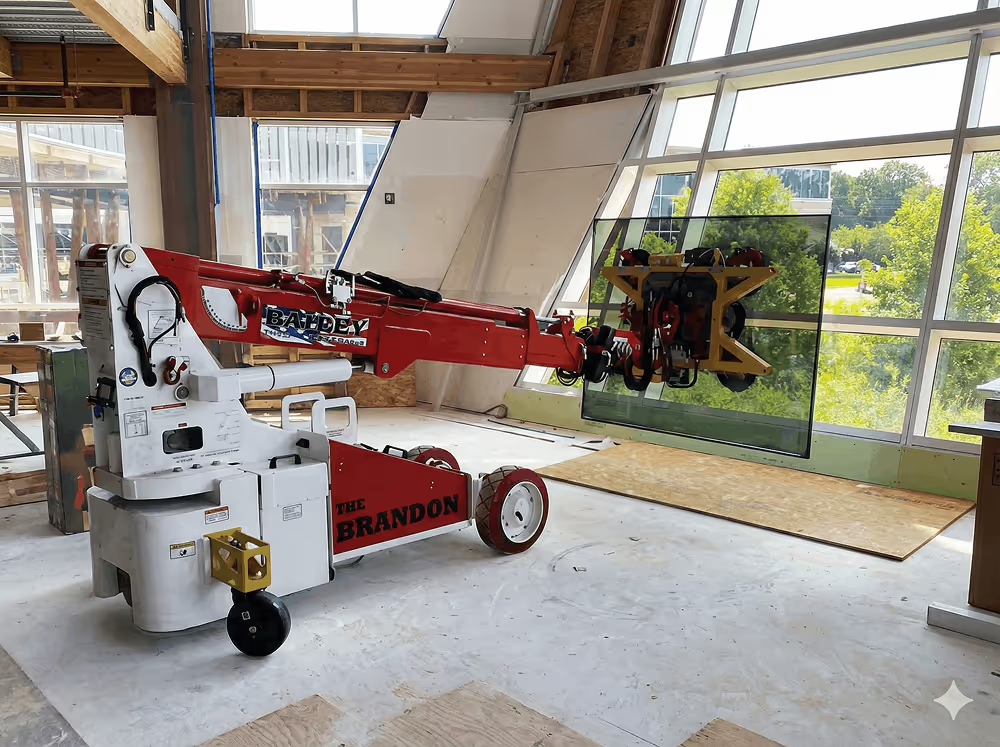
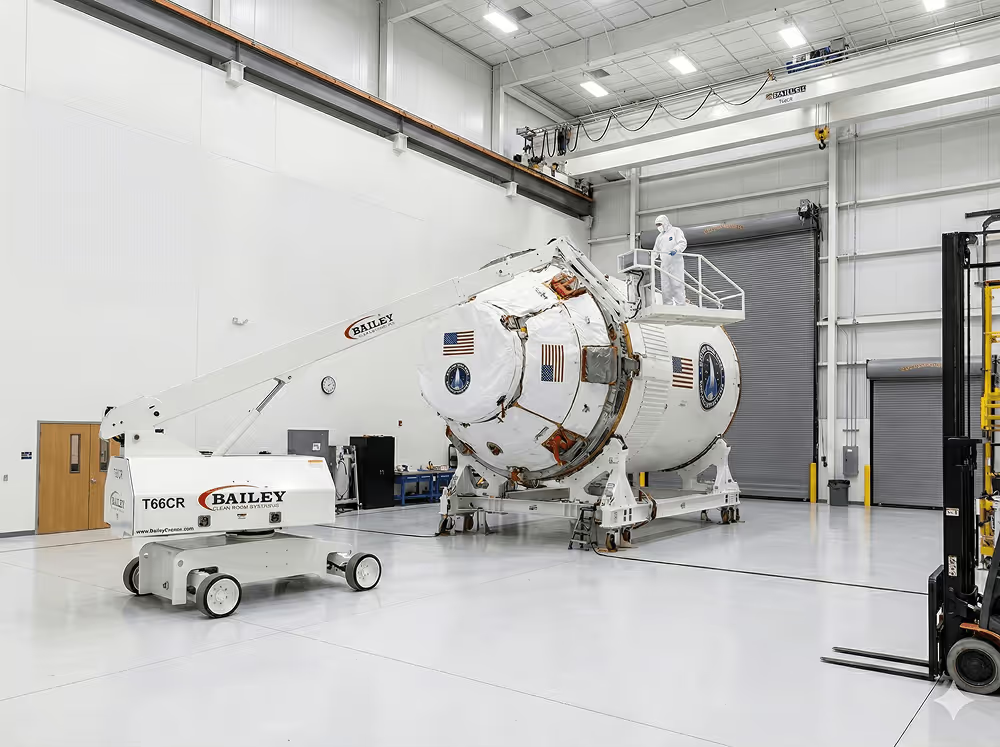
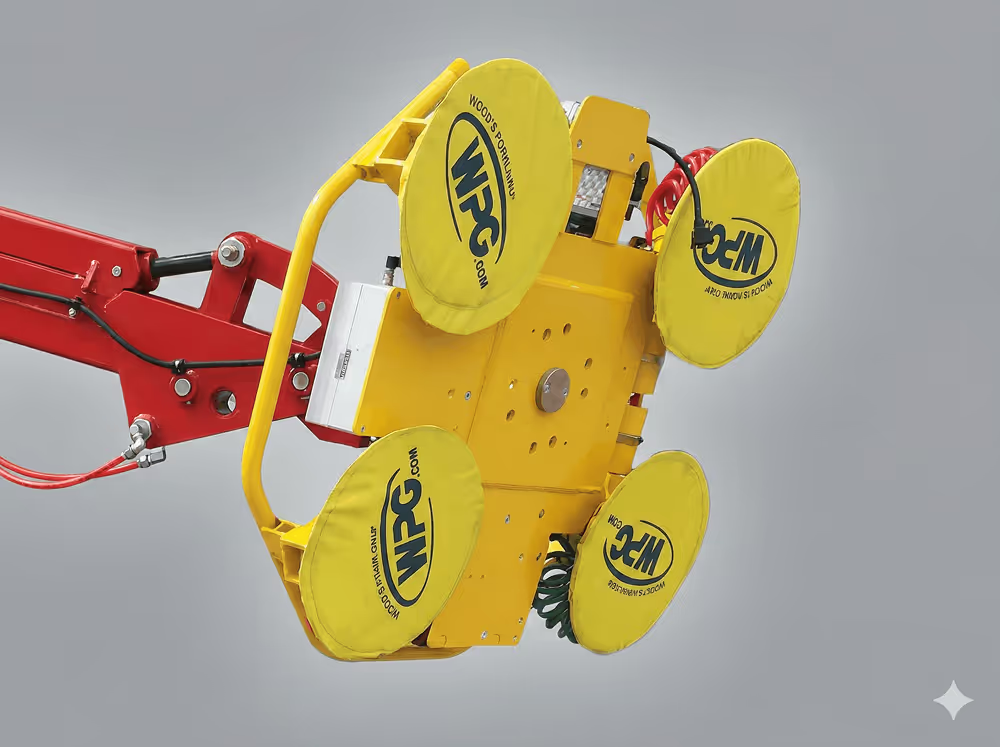
Every model in the range is attachment-based — pallet forks, lifting hooks, powered winches and vacuum manipulators mount to the same chassis — so one machine covers the mechanical, electrical and glazing scopes of an interior project instead of three. For buildings that carry a classification, Bailey also builds cleanroom-compatible lifts and Class I Division 1 explosion-proof equipment.
If the floor is the binding constraint on your project rather than the doorway, our write-up on how we solved a floor-loading problem for a major aerospace OEM walks through a real example. For a deeper look at the machine category itself, see what a pick-and-carry crane is and the complete guide to small mobile cranes.
Send us your doorway and your floor rating
Give us the narrowest opening on the route, the heaviest load, and what the floor is rated for. We'll tell you which machine fits — or design one that does.
Indoor crane FAQ
What is an indoor crane?
An indoor crane is a lifting machine designed to work inside a finished or occupied building — narrow enough to pass through interior openings, light enough for the floor it stands on, and powered so it produces no exhaust in an enclosed space. The category covers mobile machines such as pick-and-carry compact handlers, and fixed installations such as overhead bridge and jib cranes.
What types of cranes can be used indoors?
Seven types realistically work inside a building: pick-and-carry compact handlers, overhead bridge cranes, jib cranes, portable gantry cranes, spider or crawler mini cranes, manual floor cranes, and forklifts fitted with a jib boom. Only the compact handler and the forklift can pick a load up and carry it elsewhere in the building; the rest lift within a fixed footprint.
Will a crane fit through a standard doorway?
Some will. A standard single personnel door is 36 in nominal and roughly 32–34 in clear once frames and stops are accounted for, which only the smallest compact handlers can pass. A 72 in double door with both leaves open accommodates most compact handlers. The bigger practical issue is usually the turn on the far side of the door rather than the door itself.
How do I calculate floor loading for an indoor crane?
Add machine weight, rated load and rigging to get gross weight. Take the worst-case single-outrigger or wheel reaction from the manufacturer's chart at your actual boom angle and radius — not gross weight divided by four. Divide that force by the contact area to get pressure in psi, then multiply by 144 to get psf for comparison against the structural drawings.
Can you use a crane on an upper floor or mezzanine?
Often yes, but only with the structural engineer's allowable point load and uniform load confirmed in writing first. Elevated and supported slabs behave very differently from slab-on-grade. This is the situation where a lighter compact handler with large load-spreading pads succeeds and a counterbalance forklift does not.
Do indoor cranes need outriggers?
It depends on the machine and the lift. Many compact handlers pick and carry loads on their wheels within a rated envelope and deploy outriggers only for longer-radius or higher-capacity picks. When outriggers are used indoors, pads are essential — going from a bare 8 in foot to a 24 in pad cuts floor pressure by roughly 90 percent.
Why can't I just use a forklift indoors?
Three reasons. A counterbalance forklift needs aisle width to turn that finished interiors rarely have. It carries substantial deadweight to counterweight the load — a 5,000 lb-capacity truck typically weighs 8,000–11,000 lb empty — concentrated through two small tire patches. And if it is propane or diesel it produces carbon monoxide, which cannot accumulate in an enclosed space.
Are electric indoor cranes powerful enough for heavy loads?
Yes. Battery-electric compact handlers are available with lift capacities from 700 lb up past 10,000 lb. Hydraulic lifting performance is driven by the pump and cylinders rather than the energy source, so an electric machine gives up nothing on capacity while removing exhaust, noise and fuel storage from an enclosed building.
What is a walk-behind crane?
A walk-behind crane is a compact, self-propelled pick-and-carry machine that the operator controls while walking alongside it rather than riding on it. Removing the operator station makes the machine dramatically smaller, which is exactly what lets it pass through interior doorways and work in aisles where a ride-on machine cannot.
How much headroom does an indoor crane need?
Plan around the lowest obstruction on the route rather than the ceiling height. Sprinkler piping, ductwork and cable tray usually govern, and NFPA 13 requires at least 18 in of clearance below sprinkler deflectors for storage. The specifications that matter indoors are stowed travel height and usable lift beneath that lowest obstruction.
Can indoor cranes work in cleanrooms or hazardous locations?
Only if they are built for it. Cleanroom work requires particle-controlled construction, sealed bearings, compatible lubricants and non-shedding finishes. Hazardous locations such as paint and blast booths require genuinely explosion-proof equipment certified as a complete unit. Neither can be achieved by modifying a standard machine on site.
Who builds indoor cranes in the United States?
Bailey Cranes designs and manufactures compact handlers and specialty lifting equipment for interior work in Muskego, Wisconsin. Bailey is a Service-Disabled Veteran-Owned Small Business operating an ISO 9001:2015 quality system, and builds cleanroom-compatible and Class I Division 1 explosion-proof variants for classified interiors.