



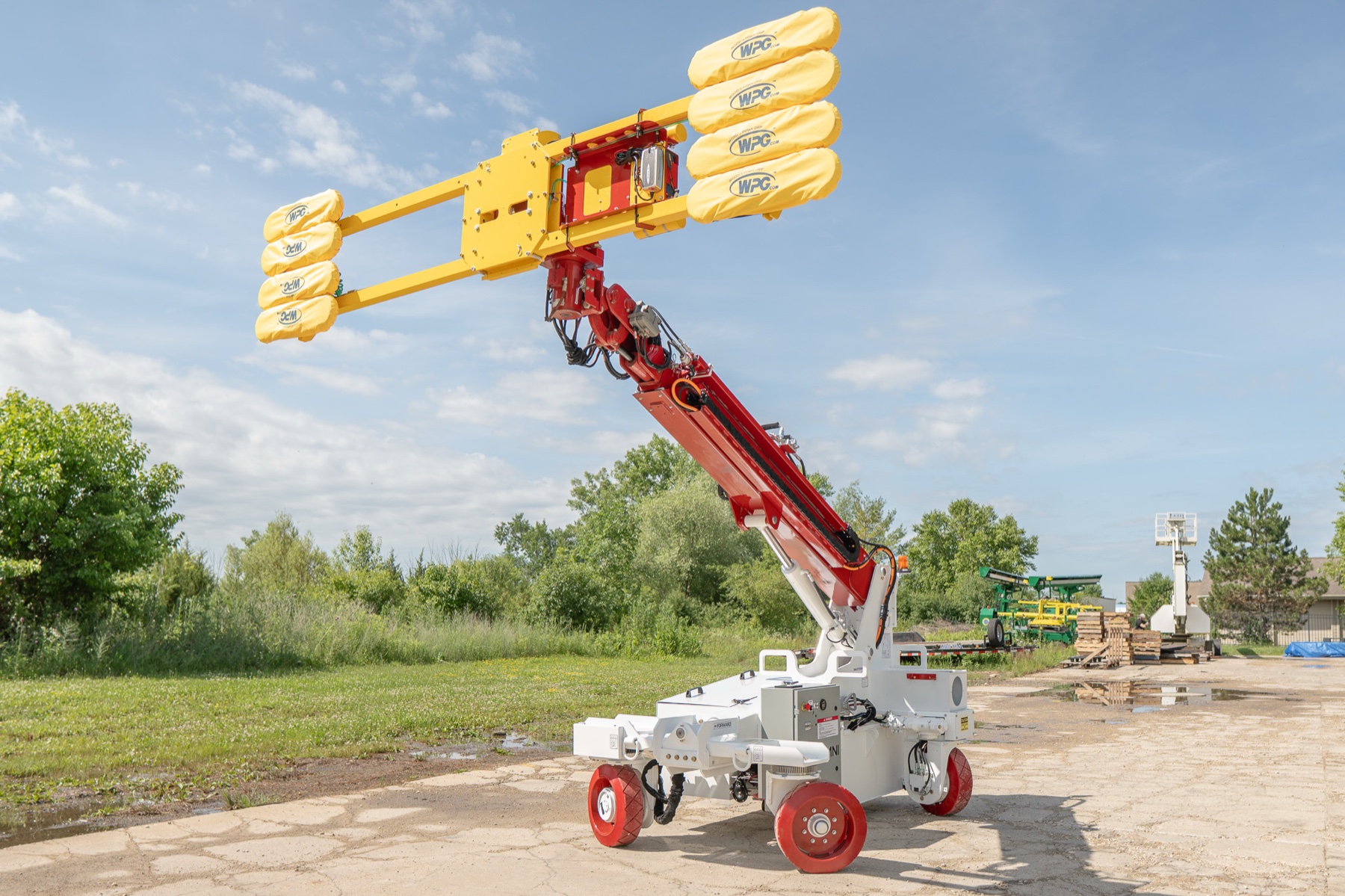
Most glass-lifting projects are specified backwards. Somebody looks up a machine's headline capacity, sees a number bigger than the pane, and orders it — then finds out on site that the rating applies at four feet of reach, not the eighteen they actually need. Size the machine from the pane and the radius, and the rest of the decision makes itself.
This guide covers what glass handling equipment actually is, how to translate between the half-dozen names the industry uses for it, how to calculate the weight you are lifting and the capacity you need at your working radius, and what to put in front of a supplier so you get a straight answer.
What is glass handling equipment?
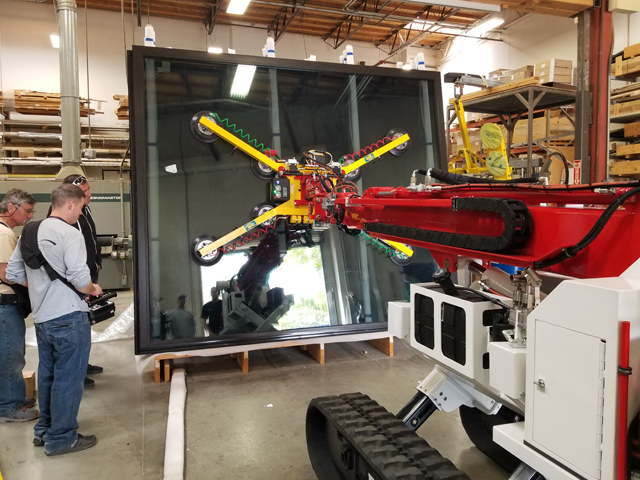
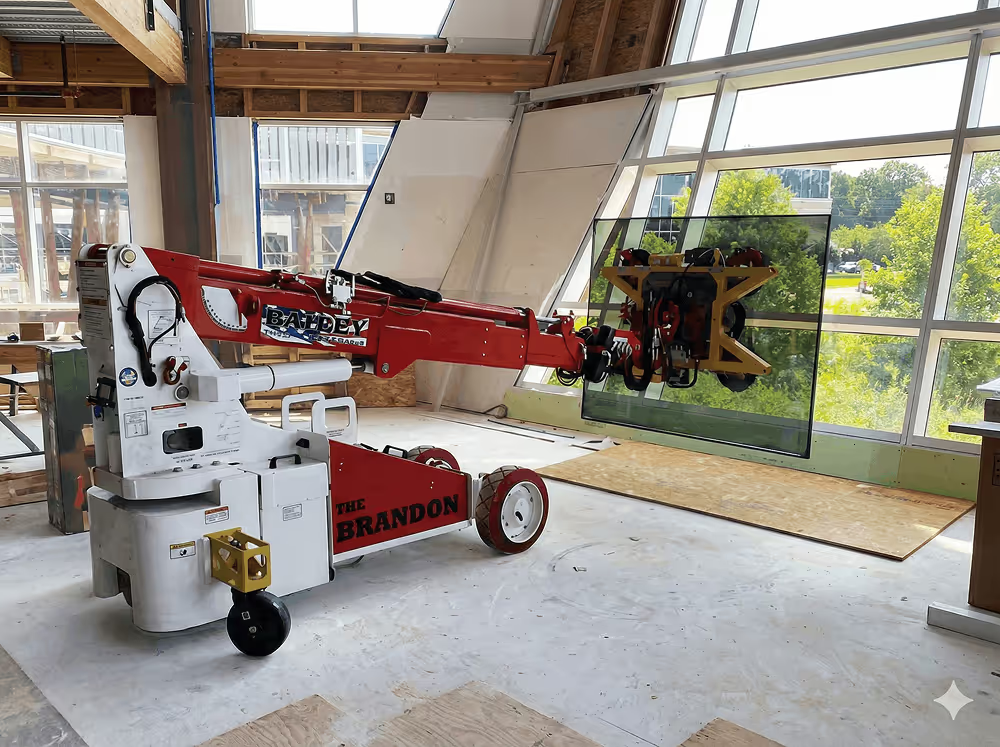
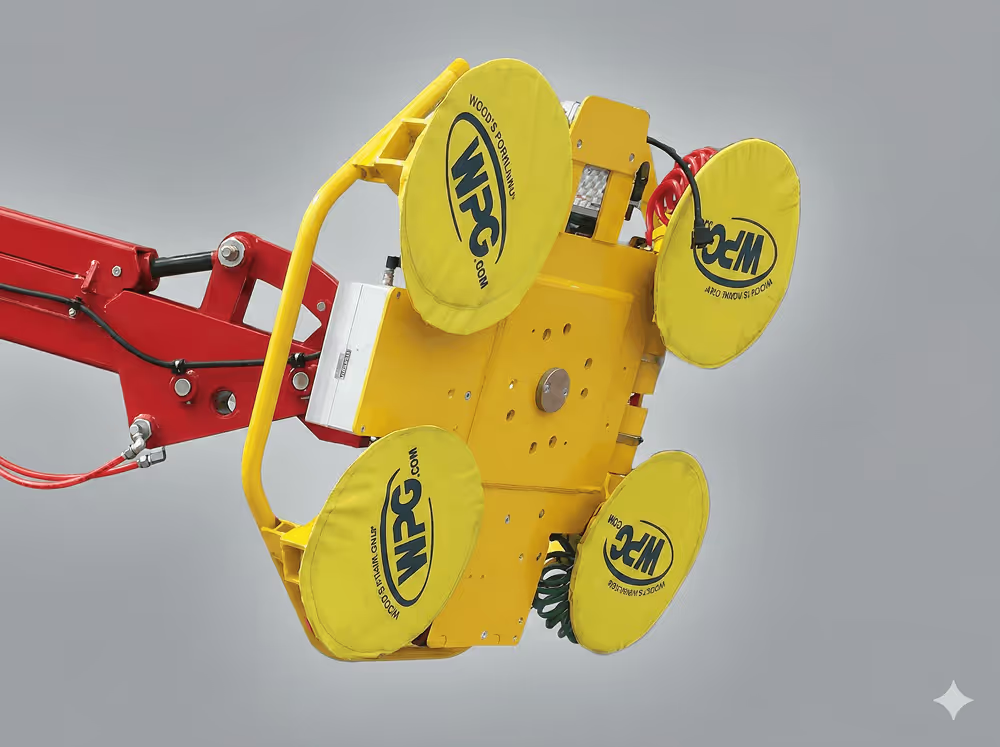
Glass handling equipment is any powered system built to lift, rotate and place glass without human hands taking the weight. A complete setup has three parts: a vacuum lifter that grips the glass by suction, a manipulator that tilts, rotates and extends it, and a carrier — a compact handler, crane or robot — that moves the whole assembly to the opening.
The category exists because glass is heavy, fragile and awkward in a specific combination. A single insulated unit for a commercial curtain wall routinely weighs 400–900 lb, has no handholds, will not tolerate point loading, and has to be presented to its opening square and under control.
It matters because glass sizes have grown faster than crews have. Architectural units that a four-person team could once carry are now routinely beyond safe manual handling, and jumbo units have pushed past what most site equipment can reach. The equipment question is no longer optional on commercial glazing work.
Vacuum lifter, manipulator, glass lifter: what the terms mean
A vacuum lifter is the attachment that grips the glass. A manipulator is the powered head that tilts and rotates it. A glass lifter or glass handler is usually the complete machine. The terms get used interchangeably in the trade, which is why quotes are so hard to compare — two suppliers can answer the same enquiry with very different scopes.
Here is the translation table. If you are collecting quotes, it is worth agreeing which layer everybody is pricing before you compare numbers.
| Term you'll see | What it actually refers to | What it does not include |
|---|---|---|
| Vacuum lifter Vacuum cup lifter | The below-the-hook attachment: a frame of suction pads, a vacuum pump or venturi, a reservoir and controls | Any means of moving it — it needs a host machine or hoist |
| Glass manipulator | The powered head that tilts, rotates and often extends the pane — commonly described as 3-axis or multi-axis | The suction pads themselves, and the carrier |
| Glass lifter Glass handler | Usually the complete machine: carrier plus manipulator plus vacuum lifter | Nothing — but confirm the vacuum attachment is actually in the price |
| Glazing robot | A compact, often tracked machine with a manipulator, built for interior glazing | Long reach — most trade capacity for compactness |
| Glass gripper | Ambiguous: sometimes a mechanical edge clamp, sometimes just a vacuum pad | — ask which one is meant |
| Glass mover Glass moving equipment | Generic; usually the whole machine, occasionally a transport cart or A-frame | — clarify before quoting |
The practical takeaway: when a quote says "glass lifter," ask whether the vacuum attachment, the manipulator and the carrier are all included. They frequently are not.
Hand tool or machine? The thresholds that decide
Handheld suction cups are a positioning aid, not a lifting system. They are appropriate for panes a crew can already safely carry. Once the pane exceeds roughly 150–250 lb, needs to go above chest height, or has to be presented at any reach, you are into machine territory — and the decision stops being about the cups and starts being about the carrier.
Three questions settle it before you look at any equipment:
- What does the heaviest pane weigh? Under about 150 lb with good access, a two-person handheld cup set is often reasonable. Above that, manual handling stops being defensible.
- How high, and how far out? Anything above chest height or beyond arm's reach needs powered lift and a manipulator. This is where most projects underestimate.
- How many, and how often? Twenty units is a rental conversation. Two thousand units, or a recurring product line, is a machine you should own.
Be honest about the second question in particular. A pane that two people can lift off a rack at waist height is a completely different problem from the same pane held out at eighteen feet and rotated into an opening.
The six types compared
Once you are past hand tools, six machine categories cover essentially all commercial glass work. They differ mainly in whether they can carry the glass to the opening or only lift it once positioned.
| Type | Typical glass capacity | Reach | Carries the load? | Best for | Main limitation |
|---|---|---|---|---|---|
| Handheld vacuum cups | Up to ~250 lb | None | By hand | Small panes, residential, final positioning | Manual handling limits; no height |
| Compact handler with 3-axis manipulator | 700 – 1,400 lb | 9 – 38 ft | Yes — drives with the pane | Curtain wall, storefront, interior glazing in finished buildings | Needs a floor path to the opening |
| Glazing robot (tracked) | 500 – 2,000 lb | Low to moderate | Limited | Interior glazing, tight footprints, stair access | Trades reach for compactness |
| Vacuum lifter on a telehandler or forklift | Host-dependent | Host-dependent | Yes | Sites that already own the host machine | Load-centre penalty; coarse control; usually outdoor |
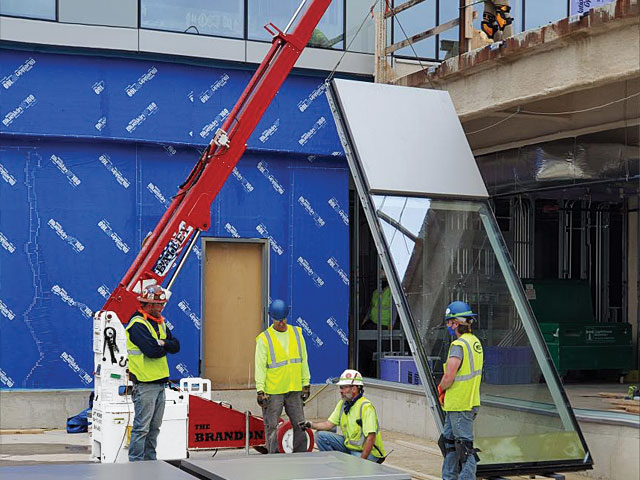
| Spider / crawler crane with glass attachment | Varies widely | High | No — sets on outriggers | Atriums, skylights, high or awkward reach | Set-up time; cannot travel under load |
| Overhead crane or jib with vacuum lifter | Very high | Fixed envelope | Within its bay | Glass fabrication plants, repetitive in-plant handling | Fixed installation; serves one area |
Capacities are typical planning ranges. Always work from the specific machine's glass load chart rather than a category average.
The distinction that matters most on a jobsite is the fourth column. A spider crane sets up, lifts, and sets down within its outrigger footprint. A compact handler picks the pane up and drives it to the opening — which is the whole job when the glass is on the dock and the opening is at the far end of a finished floor.
How to size a glass lifter — worked example
Calculate the pane weight from area and glass thickness, add the vacuum attachment, then check that total against the machine's capacity at your actual working radius — not its headline rating. Architectural glass weighs approximately 13 lb per square foot per inch of thickness (2.5 kg/m² per mm). A quarter-inch lite is about 3.3 lb/ft².
The step almost everyone skips is the last one. Glass load charts decline steeply with radius, and the number on the brochure is the capacity close in.
Step 1 — Weigh the pane
Take a commercial insulated glass unit, 5 ft × 12 ft, made from two quarter-inch lites:
- Area = 5 × 12 = 60 ft²
- Total glass thickness = two ¼ in lites = 0.5 in
- Weight = 60 ft² × 13 lb/ft²/in × 0.5 in = 390 lb
- Add roughly 8% for spacer, sealant and any applied film = 421 lb
Step 2 — Add the attachment
The vacuum lifter is part of the load. A multi-cup rotating and tilting frame sized for this pane typically runs 250–400 lb. Taking 300 lb:
421 lb glass + 300 lb attachment = 721 lb at the boom tip.
Step 3 — Check capacity at your radius, not the headline
Here is where the specification is usually won or lost. Using the published glass load chart for a CH 10 OMNI, capacity steps down as the boom extends:
| Working radius | Chart capacity | 721 lb load | Verdict |
|---|---|---|---|
| Close in | 1,100 lb | 721 lb | Comfortable margin |
| Moderate reach | 850 lb | 721 lb | Works, with margin |
| Extended reach | 750 lb | 721 lb | Works — but thin. Verify against the actual chart |
| Long reach | 550 lb | 721 lb | Over capacity — will not lift |
| Maximum reach | 400 lb | 721 lb | Well over capacity |
Capacity steps taken from the published CH 10 OMNI glass lifter load chart. Radii are indicative — always work from the chart supplied with your machine and configuration.
The same 721 lb pane is an easy lift at short radius and an impossible one at full extension. The pane weight is not the specification. The pane weight at your working radius is the specification.
So the sizing question is never "can it lift 721 pounds." It is "can it lift 721 pounds at the reach I need, from a position the machine can physically occupy." Establish where the machine can stand first, measure the radius from there to the opening, and read the chart at that number.
Vacuum cups: capacity, surfaces and the governing standards
Vacuum lifters are below-the-hook lifting devices, governed by ASME B30.20 and designed to ASME BTH-1. Two consequences matter in practice: the pad rating you are given already includes the required design factor, so applying your own on top does not add real margin; and the device must account for what happens on loss of vacuum or power.
Beyond the rating on the plate, four things change how much a cup will actually hold:
Orientation
Pads carry far more with the glass horizontal than on edge. Vertical lifting depends partly on friction at the seal, and pads are rated separately for each orientation. If the manipulator rotates the pane under load, the governing rating is the worst orientation in the cycle.
Surface condition
Vacuum needs a smooth, clean, non-porous surface. Dust, water film, release agents and frost all degrade the seal. Wipe the contact area before every pick — this is the single most common cause of a lost pane.
Coatings and texture
Soft-coat low-E surfaces, ceramic frit, sandblasted and heavily patterned glass can reduce holding force or be marked by the pads. Confirm which face is the lifting face before the unit arrives, not on the deck.
Curvature
Bent and curved glass needs contoured pads matched to the radius. A flat pad on a curved lite seals on a fraction of its area and its rating no longer applies.
Two operational rules are worth stating plainly because they are where incidents happen: never lift over people — establish and enforce an exclusion zone beneath the pane — and treat the vacuum warning as a stop condition, not a caution. If the indicator or alarm activates, set the glass down at the first safe opportunity.
Site access, the constraint that kills the spec
A correctly sized machine that cannot reach the opening is worth nothing. On interior and finished-building glazing, access decides the equipment as often as capacity does:
- The narrowest clear opening on the route — measured with the door stops in place, not the nominal size.
- Floor loading — particularly on elevated slabs and over podium decks. Machine weight plus glass plus attachment, checked against the structural drawings.
- Floor protection — non-marking tires and clean wheels are close to mandatory on finished and polished floors.
- Power and emissions — battery-electric for occupied and enclosed buildings; combustion equipment is usually not permitted indoors.
These constraints are covered in detail in our guide to getting a crane inside a finished building, including how to run the floor-loading calculation. If your glazing work is interior, read that alongside this.
The spec sheet to send your supplier
Send these numbers and you will get a specific machine recommendation instead of a brochure. Every line comes off a shop drawing, a tape measure or a glass schedule.
- Largest pane — width × height, and total glass thickness or the full make-up
- Heaviest pane — if it is not the largest one
- Glass type — annealed, tempered, laminated, IGU; and any coating or frit
- Which face is the lifting face — critical for soft-coat low-E
- Flat or curved — and the radius if curved
- Required reach at the set point, measured from where the machine can actually stand
- Required lift height at the opening, plus anything overhead in the way
- Orientation changes — does the pane need to rotate or tilt under load?
- Narrowest clear opening on the route from the dock to the work
- Floor type and rating — slab-on-grade, elevated slab, podium deck; allowable point load
- Floor finish — and whether marking is acceptable
- Indoor, outdoor or both — and whether combustion equipment is permitted
- Volume and schedule — unit count and duration, which decides rent versus buy
Bailey's glass handling line
Bailey builds compact handlers with vacuum glass attachments and multi-axis manipulators — machines that drive the pane to the opening rather than setting up beside it. The line scales by reach and glass capacity:
| Model | Vertical reach | Horizontal reach | Glass capacity | Power |
|---|---|---|---|---|
| CH 10 OMNI | 38 ft | 27 ft | 1,100 lb | 35 HP AC, battery electric |
| CH 4 OMNI | 27 ft | 16 ft | 1,100 lb | 36V battery |
| CH Trax | 24 ft | 14 ft | 1,400 lb | Propane, telescoping tracks |
| CH 6 | 24 ft | 14 ft | — | 24V battery |
| Junior | 24 ft | 14 ft | 1,000 lb | 24V battery |
| CH Compact Handler | 9 ft | 3 ft | 700 lb | 24V battery |
Specifications as published on the product pages; final capacity depends on attachment, orientation and radius. Browse the full glass lifter line.
All of them use Wood's Powr-Grip vacuum attachments and a multi-axis manipulator, so a single operator can crab a lite sideways while keeping it square to the opening, rotate it about the machine's own centre in a tight lobby, and present it without a second machine. The battery models run zero-emission and quiet enough for occupied buildings; the tracked CH Trax handles uneven ground and side slopes where wheels will not go.
Send us your glass schedule and your reach
Give us the largest pane, the make-up, and how far out you need to place it. We'll tell you which machine fits — or engineer one that does.
Glass handling equipment FAQ
What is glass handling equipment?
Glass handling equipment is any powered system built to lift, rotate and place glass without human hands taking the weight. A complete setup combines a vacuum lifter that grips the pane by suction, a manipulator that tilts and rotates it, and a carrier such as a compact handler, crane or glazing robot that moves the assembly to the opening.
What is the difference between a vacuum lifter and a glass manipulator?
A vacuum lifter is the attachment that grips the glass — a frame of suction pads with a pump, reservoir and controls. A manipulator is the powered head that tilts, rotates and extends the pane, commonly described as 3-axis. Neither moves itself; both need a carrier machine. When a supplier quotes a "glass lifter," confirm which of the three layers is actually included.
How much does architectural glass weigh?
Approximately 13 lb per square foot per inch of thickness, or 2.5 kg/m² per millimetre. A quarter-inch lite is about 3.3 lb/ft². A 5 ft × 12 ft insulated unit made from two quarter-inch lites works out to roughly 390 lb of glass, or about 420 lb once spacer and sealant are included.
How do I calculate what size glass lifter I need?
Three steps. Calculate pane weight from area and total glass thickness at 13 lb/ft² per inch. Add the vacuum attachment, typically 250–400 lb for a multi-cup rotating frame. Then check that combined weight against the machine's glass load chart at your actual working radius — not its headline capacity, which applies only at short reach.
Do I need a machine, or will handheld suction cups work?
Handheld cups are a positioning aid for panes a crew can already safely carry, generally under about 150–250 lb with good access. Once the pane is heavier, needs to go above chest height, or has to be presented at any reach, you need a powered manipulator on a carrier. Height and reach push more projects into machine territory than weight does.
How many vacuum cups do I need to lift a glass panel?
Enough that the combined rated capacity of the pads, in the orientation you are actually lifting, exceeds the pane weight. Pads are rated separately for horizontal and vertical lifting because on-edge lifting relies partly on friction at the seal. Those published ratings already include the design factor required by ASME B30.20, so adding your own factor on top does not create real margin.
What standards govern vacuum glass lifters?
Vacuum lifters are below-the-hook lifting devices. ASME B30.20 covers their construction, marking, inspection, testing and operation, and ASME BTH-1 covers their design. Together they require rated-load marking, periodic inspection, and provisions for what happens on loss of vacuum or power.
Can a vacuum lifter handle low-E or coated glass?
Yes, but the lifting face matters. Soft-coat low-E surfaces, ceramic frit and heavily textured glass can reduce holding force or be marked by the pads. Confirm with the glass supplier which face is the lifting face before the units arrive on site, and make sure the contact area is clean and dry at every pick.
Can glass handling equipment work inside a finished building?
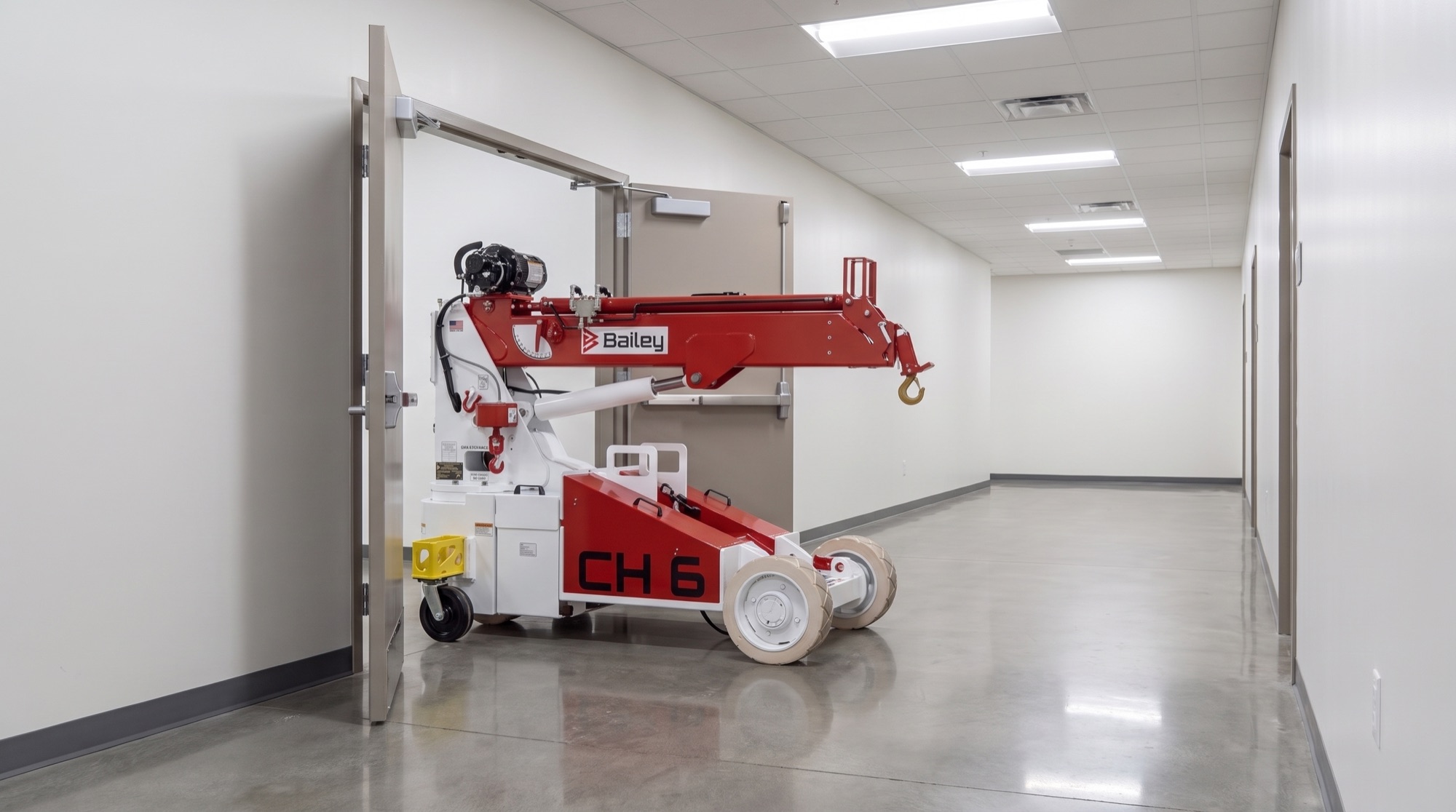
Battery-electric compact handlers are built for exactly that. They pass through interior openings, run zero-emission and quiet enough for occupied space, and use non-marking tires on finished floors. The constraints to check first are the narrowest clear opening on the route, the floor's allowable point load, and the lowest overhead obstruction.
What is a glazing robot?
A glazing robot is a compact, usually tracked machine with a powered glass manipulator, designed for interior glazing in tight spaces. It trades reach for a small footprint and the ability to pass through doorways and sometimes up stairs, which makes it a fit for interior partitions and lobbies rather than long-reach curtain-wall work.
How much glass can a Bailey compact handler lift?
From 700 lb on the compact CH Compact Handler up to 1,400 lb on the CH Trax, with the CH 10 OMNI rated to 1,100 lb of glass at 38 ft of vertical reach and 27 ft horizontal. Effective capacity always depends on attachment weight, pane orientation and working radius, so the load chart governs rather than the headline figure.
Who manufactures glass handling equipment in the United States?
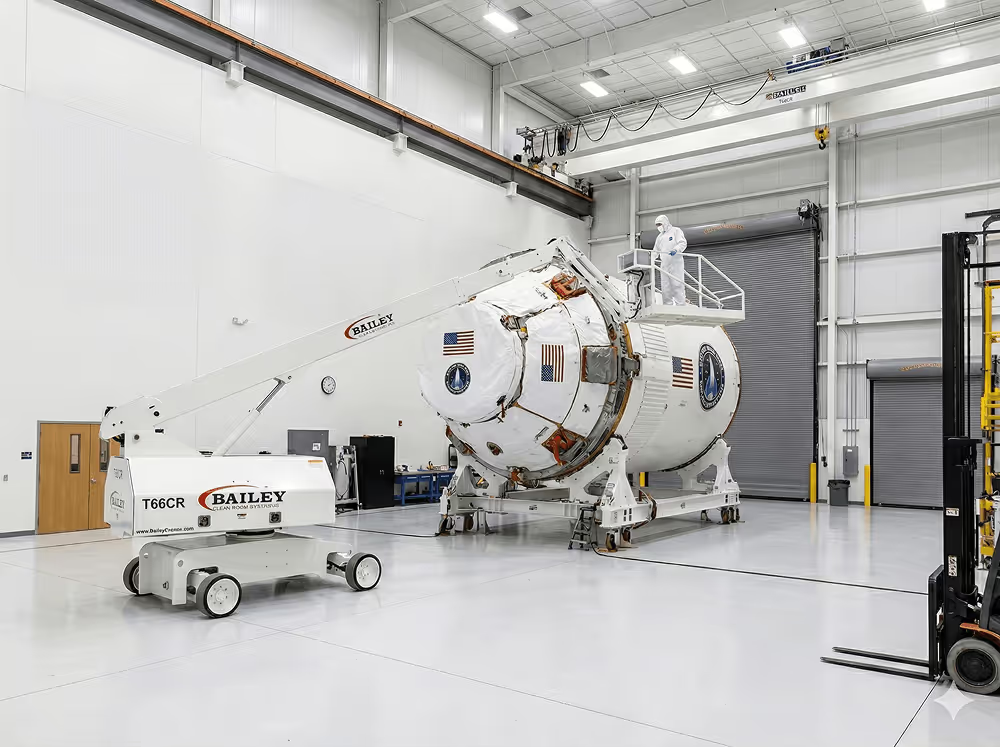
Bailey Cranes designs and builds compact handlers with vacuum glass attachments and multi-axis manipulators in Muskego, Wisconsin. Bailey is a Service-Disabled Veteran-Owned Small Business operating an ISO 9001:2015 quality system, and also builds cleanroom-compatible and Class I Division 1 explosion-proof machines for classified environments.